
Many companies first understand GEO as a form of AI reputation monitoring.
They want to know whether ChatGPT, Perplexity, Gemini, Google AI Overviews, or other AI systems describe their brand correctly, mention negative information, or recommend competitors instead.
That is a valid use case.
But it is not the whole story.
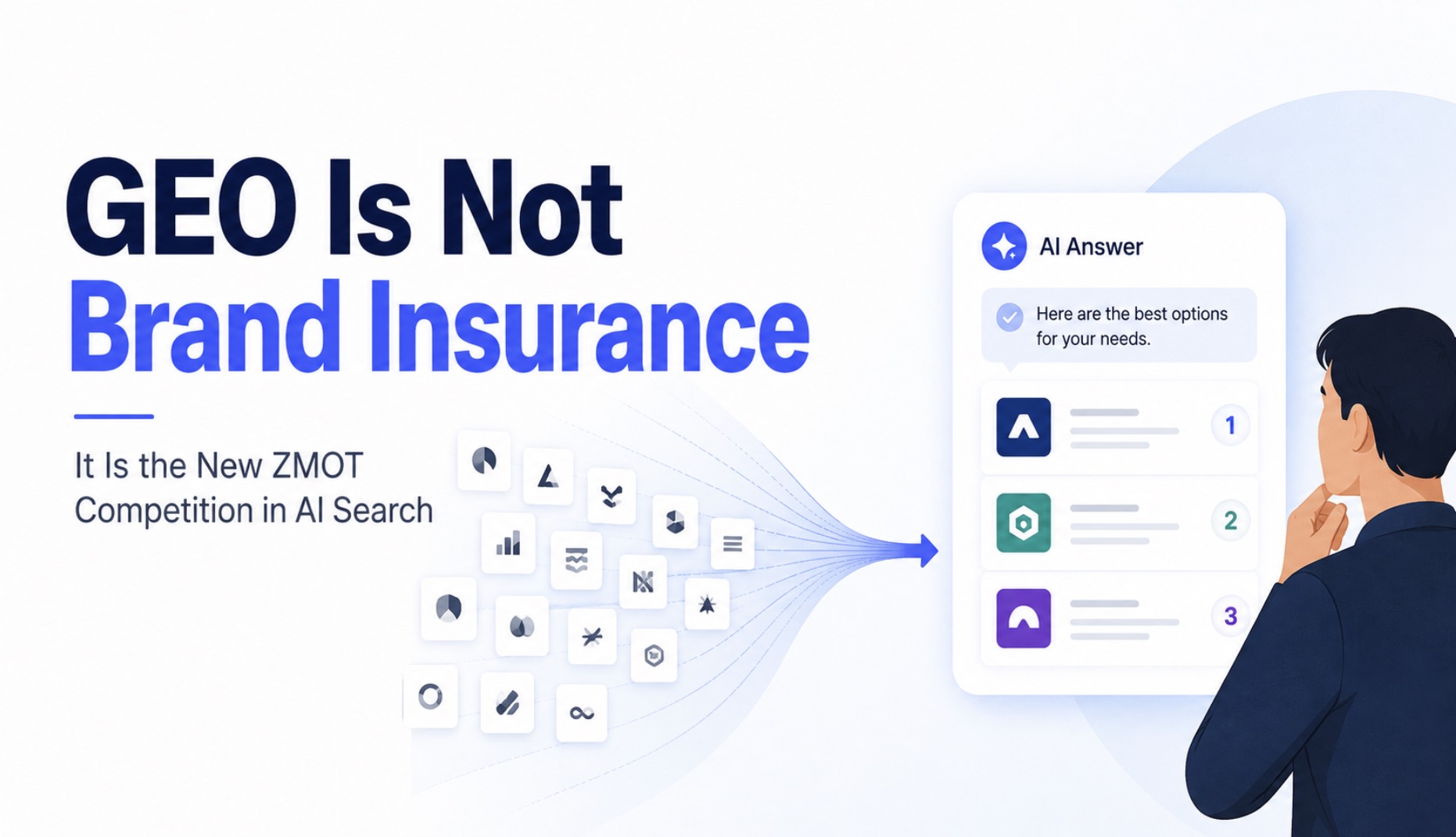
If GEO is positioned only as brand protection, it becomes a defensive cost. It may be treated like insurance: useful when something goes wrong, but easy to ignore when budgets are tight.
The bigger value of GEO is offensive.
GEO is about whether your brand appears inside the AI answers that shape customer consideration.
When users ask AI tools to recommend vendors, compare products, shortlist solutions, or explain which option is best for their situation, your brand is either part of the answer or it is not.
That is why GEO should be treated as a growth channel, not only a monitoring function.
From Search Results to AI Answers
Google introduced the Zero Moment of Truth, or ZMOT, in 2011 to describe the online research moment before purchase. The idea was simple: customers often form preferences before they enter a store, speak to a salesperson, or click the final purchase button.
That logic still matters.
But AI compresses the experience.
In traditional search, a user may open many pages, read reviews, compare vendors, and slowly build a shortlist.
In AI search, the user may ask:
Which CRM is best for a 50-person B2B team?
What are the best AI customer support platforms for ecommerce?
Which GEO agency should a B2B SaaS company consider?
How does this brand compare with its competitors?
Which solution is best if we have a limited budget?
Instead of presenting a long list of links, the AI system may generate a short answer, a comparison table, or a set of recommended options.
This changes the competitive surface.
The brand no longer competes only for a ranking position.
It competes for inclusion in the answer.
GEO Competes for the Consideration Set
Traditional SEO is often explained as a traffic channel.
Higher rankings can lead to more clicks.
GEO is different. It competes for the consideration set.
McKinsey’s consumer decision journey framework describes purchase behavior as a more circular process than the traditional funnel, with active evaluation playing a major role as customers research and revise their options.
AI changes that evaluation stage.
When a user asks for “the top three tools” or “the best options for my use case,” the AI answer may create a short consideration set for them.
For brands, the key question becomes:
Are we included in the AI-generated shortlist?
If the answer is no, the user may never search for your brand, visit your website, or speak to sales.
That is why GEO is not just a visibility metric.
It is a competition for early consideration.
Why GEO Should Not Be Framed as Insurance
Insurance protects against risk.
GEO does help with risk. It can reveal inaccurate brand descriptions, negative AI summaries, outdated information, or competitor bias.
But if that is the only value proposition, GEO will be underfunded.
A stronger GEO program asks growth-oriented questions:
Are we mentioned for high-intent prompts?
Are we included in AI recommendations?
Are our pages cited as sources?
Why are competitors recommended more often?
Is our positioning accurate in AI answers?
Which sources influence how AI systems describe us?
What content do we need to build to enter the answer?
These questions connect GEO to revenue influence, demand generation, and market positioning.
In many buying journeys, users do not ask AI after they already know every brand.
They ask AI to decide which brands deserve attention.
That makes AI answers a new decision filter.
Start with “Finalist Diagnosis”
A brand should not start GEO by publishing random articles.
It should start by diagnosing its position inside AI recommendations.
Build a focused prompt set.
Include questions such as:
Category questions
Comparison questions
Vendor-selection questions
Pricing and risk questions
Use-case questions
Competitor-alternative questions
Industry-specific buying questions
Then test these prompts across AI search and assistant platforms.
For each answer, record:
Whether your brand appears
Which competitors appear
Whether your website is cited
Whether third-party sources are cited
Whether the brand description is accurate
Whether outdated information appears
Which prompt clusters exclude your brand
This gives the marketing team a baseline.
The point is not to create a vanity dashboard.
The point is to understand where the brand is missing from AI-assisted decision-making.
GEO Does Not Change the Model. It Changes the Sources.
Brands cannot directly control how AI models answer every question.
But brands can improve the information environment that AI systems use.
This is where GEO becomes practical.
Google’s Search Central documentation for AI features explains that website owners should still focus on fundamentals such as crawlability, indexability, visible text, and structured data that matches the visible page content.
This matters because AI visibility is not magic.
At least in publicly documented search experiences, discoverable, clear, and reliable web content remains a foundation.
Brands should build four types of sources.
1. Owned Website Sources
Your website should clearly explain:
Who your brand serves
What problem you solve
Which use cases you support
How your product or service works
What makes you different
What evidence supports your claims
What questions buyers commonly ask
Avoid vague claims such as “industry-leading,” “one-stop solution,” or “trusted partner” without proof.
AI systems need specific information that can support an answer.
2. Answer-Ready Content Sources
GEO content should be built around customer questions, not only keywords.
Useful content types include:
Buyer guides
Comparison pages
FAQ pages
Use-case pages
Product explainers
Case studies
Industry reports
Pricing and selection guides
Risk and limitation pages
This type of content helps AI systems form clearer answers.
3. Third-Party Trust Sources
AI systems may interpret a brand through sources beyond its own website.
Useful external signals can include:
Media coverage
Review platforms
Industry directories
Partner pages
Expert commentary
Public case studies
Community discussions
Analyst or research mentions
The goal is not to manufacture fake mentions.
The goal is to create a consistent, verifiable public footprint.
4. Structured Information Sources
AI systems benefit from content that is easy to parse.
That means using:
Clear headings
Definitions
Lists
Tables
Comparison criteria
FAQs
Step-by-step explanations
Case summaries
Internal links
A long page is not automatically useful.
A clear page is.
A Practical GEO Workflow
A practical GEO program can follow five steps.
Step 1: Define High-Value Prompts
Start with the questions that matter commercially.
Ask:
If AI answers this question without mentioning us, would it hurt our business opportunity?
Those prompts form your GEO priority set.
Step 2: Test Current AI Visibility
Run the same prompt set across multiple AI platforms.
Record mentions, citations, competitors, source types, and answer accuracy.
This creates a baseline.
Step 3: Diagnose Why the Brand Is Missing
If the brand does not appear, possible causes include:
Weak owned content
Poor crawlability
Vague positioning
Missing comparison pages
Limited third-party proof
Stronger competitor source coverage
Outdated or inconsistent brand descriptions
Lack of structured, answer-ready content
Different causes require different actions.
Step 4: Build Better Source Material
Fix the missing source layer.
For example:
If comparisons are missing, build comparison pages.
If proof is weak, publish case studies.
If FAQs are missing, turn real sales questions into answer pages.
If AI descriptions are wrong, update owned and third-party profiles.
If competitors dominate, analyze which pages and sources support their visibility.
The goal is not more content.
The goal is better evidence.
Step 5: Retest and Maintain
GEO is not a one-time project.
AI answers change. Competitors update content. New prompts emerge.
Run regular tests and monitor:
Brand mention rate
Citation rate
Competitor presence
Answer accuracy
High-intent prompt coverage
Source quality
Prompt clusters where the brand remains absent
This turns GEO into an operating system, not a one-off campaign.
Who Should Own GEO?
If GEO is framed as reputation monitoring, it may sit with PR.
But effective GEO requires multiple teams.
SEO teams handle crawlability, internal linking, and technical visibility.
Content teams build answer-ready assets.
Brand teams maintain positioning consistency.
PR teams strengthen third-party sources.
Product marketing teams clarify use cases and competitive differences.
Growth teams connect AI visibility to pipeline and demand signals.
GEO is not simply a tool purchase.
It is a cross-functional visibility program for the AI search era.
What GEO Cannot Promise
A credible GEO program should not promise:
Guaranteed AI rankings
Permanent recommendation placement
Exact revenue numbers
Instant results
Control over every AI answer
Visibility from thin content
Long-term results from fake reviews or spam mentions
AI systems change, and user prompts vary.
GEO can improve the probability that a brand is understood, cited, and recommended.
It cannot fully control the answer.
Final Thoughts
GEO is not brand insurance.
It is the new competition for decision entry.
In traditional search, customers often expanded their options through search results.
In AI search, customers may begin with a compressed shortlist created by an AI answer.
If your brand is missing from that answer, you may be excluded before the buyer even begins deeper research.
That is why GEO should focus less on generic traffic and more on trusted answer inclusion.
The brands that win will be the ones that provide clear, verifiable, structured, and useful source material for AI systems.
In search, you competed for rankings.
In AI search, you compete for a trusted place in the answer.
常見問題
What is GEO in AI search?
GEO, or Generative Engine Optimization, is the process of improving how a brand appears in AI-generated answers, including mentions, citations, comparisons, and recommendations.
How is GEO different from SEO?
SEO focuses on search rankings and organic traffic. GEO focuses on whether AI systems understand, cite, and recommend your brand in generated answers. SEO fundamentals still support GEO.
Why should brands care about AI-generated shortlists?
AI-generated shortlists may shape which brands users consider. If a brand is missing from those answers, it may be excluded before the user visits websites or talks to sales.
Can GEO guarantee AI recommendations?
No. GEO cannot guarantee permanent placement or fixed rankings. It can improve the quality, clarity, and trustworthiness of the sources AI systems use.