
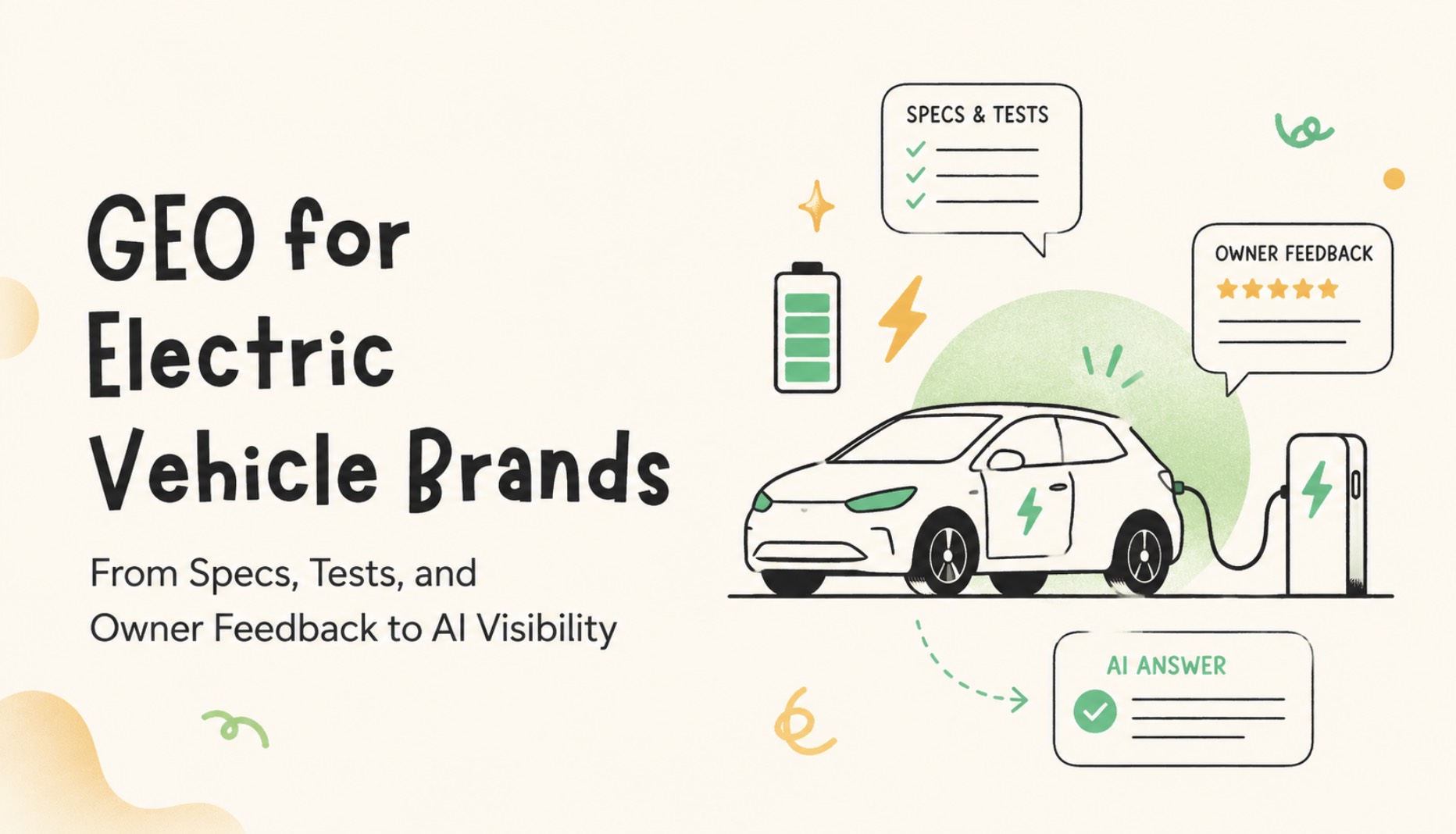
Electric vehicle buyers no longer rely only on search engines, review websites, or dealership conversations.
Many now ask AI tools complex buying questions:
Which electric SUV under $35,000 is best for a family?
Which model has the most reliable real-world range?
How do these two EVs compare in assisted driving?
Which brand has better owner feedback after one year?
What should I check before booking a test drive?
These are not simple keyword searches. They combine budget, driving scenarios, technical specs, safety, comfort, service, and competitor comparison.
For EV brands, this changes the role of content.
The goal is no longer only to rank for model keywords. The goal is to become a source that AI systems can understand, verify, cite, and recommend.
Why EV Brands Need GEO
Electric vehicles are high-consideration products.
A buyer will not choose a car based only on a slogan such as “long range,” “smart driving,” or “premium comfort.” They want proof.
They compare battery size, range standards, charging speed, assisted-driving features, safety systems, cabin space, service coverage, warranty terms, and real owner feedback.
AI search compresses this research process.
Instead of showing users dozens of links, an AI answer may summarize the market and list only a few recommended models. If your brand is missing from that answer, the buyer may never consider you.
Google’s documentation for AI features in Search also states that existing SEO fundamentals remain relevant for AI Overviews and AI Mode, including crawlability, internal linking, textual content, page experience, and structured data that matches visible content.
That is why GEO for EV brands should combine technical SEO, structured product content, third-party evidence, and AI visibility monitoring.
AI Needs Evidence, Not Marketing Claims
Many EV brand websites are visually strong but weak as source material.
Common phrases include:
Long-range performance
Intelligent cabin
Advanced driver assistance
Premium comfort
Industry-leading innovation
These claims may work in advertising, but they are not enough for AI answers.
AI systems need information that can support a specific recommendation.
Useful source material includes:
Official model specs
Battery capacity
Range standard and testing method
Charging speed
Driver-assistance hardware
Safety features
Warranty information
Third-party reviews
Long-term owner feedback
Competitor comparisons
Common buyer FAQs
For example, China’s Ministry of Industry and Information Technology publishes official vehicle product announcements and new-energy vehicle catalog information, which are important public references for vehicle eligibility and technical information.
EV brands should treat this kind of verifiable information as part of their AI search foundation.
Build an EV Prompt Matrix
EV GEO should begin with customer questions, not only keywords.
A useful prompt matrix can include four layers.
1. Buyer Persona and Driving Scenario
Different buyers ask different questions.
A family buyer may care about space, safety, and long-distance comfort.
A city commuter may care about energy consumption, parking, charging access, and cabin usability.
A technology-focused buyer may care about chips, sensors, assisted-driving features, and software updates.
A northern-region buyer may care about winter range and heating performance.
Each segment should have dedicated content.
2. Technical Specs and Performance
AI answers often rely on specs.
Your content should explain:
What range standard is used?
What is the battery capacity?
What charging speed is supported?
What driver-assistance hardware is included?
Which safety features are standard?
What use cases is the model best suited for?
What are the limits of the model?
The clearer the specs are, the easier it is for AI systems to understand when your model should be recommended.
3. Competitor Comparisons
EV buyers frequently ask comparison questions.
Examples include:
Model A vs Model B: which is better for families?
Which EV SUV has better real-world range?
Which brand has better assisted-driving performance?
What are the best alternatives to this model?
A useful comparison page should be honest and specific.
It should explain strengths, limitations, ideal users, and cases where a competitor may be a better fit.
That kind of balanced content is more trustworthy than pure promotion.
4. Purchase and Service Decisions
A car purchase does not end with product research.
Buyers also care about:
Test drives
Dealer coverage
Service centers
Warranty policy
Financing
Trade-in support
Maintenance cost
Delivery timeline
Software updates
AI systems are more likely to recommend a brand confidently when the full purchase path is clear.
What Content Assets Should EV Brands Build?
EV brands should prioritize pages that are specific, structured, and useful.
Recommended content assets include:
Model specification pages
Battery and charging explainers
Assisted-driving feature pages
Safety feature pages
Owner FAQ pages
Long-term owner stories
City commuting guides
Family-use scenario pages
Winter range content
Competitor comparison pages
Test-drive guides
Warranty and service pages
Third-party review summaries
Each page should include:
A direct answer
Key specs
Suitable use cases
Limitations
Real-world examples
Comparisons
FAQs
Internal links
This format helps both users and AI systems understand the content quickly.
Why Owner Feedback Matters
EV performance is not only about official specs.
Long-term ownership reveals issues that a brochure cannot show, such as:
Real-world range
Charging convenience
Software stability
Cabin usability
Service quality
Assisted-driving experience
Winter performance
Resale concerns
If AI systems see strong specs but weak owner feedback, they may be cautious in recommendations.
EV brands should not fake reviews or flood forums. Instead, they should encourage real owners to share detailed, scenario-based feedback.
A one-year ownership story with range, service, charging, and software details is more useful than a generic positive comment.
What Should an EV GEO Dashboard Track?
An EV GEO dashboard should monitor:
Brand mentions in AI answers
Model recommendations
Citations to official pages
Citations to third-party reviews
Competitor presence
Owner feedback themes
Incorrect model specs
Outdated pricing or policy information
Pages most often cited
Prompts where the brand is missing
Specification errors are especially important.
If AI systems confuse an old model with a new model, misstate battery capacity, or describe a competitor feature as yours, the brand should update its official content and supporting sources quickly.
A 60-Day EV GEO Plan
Days 1–10: Collect Buyer Questions
Gather real questions from sales teams, dealership conversations, customer support, search queries, review platforms, and owner communities.
Group them by budget, model type, family use, driving range, assisted driving, service, and competitor comparison.
Days 11–25: Build Structured Model Pages
Create or improve pages for priority models.
Each page should include specs, scenarios, limitations, FAQs, comparison context, and internal links.
Days 26–40: Strengthen Evidence Sources
Organize third-party reviews, official specs, long-term owner stories, media coverage, and warranty information.
Make sure important information is available as crawlable text.
Days 41–60: Test AI Answers and Fix Gaps
Run a fixed set of prompts across major AI platforms.
Track whether the brand appears, which sources are cited, how competitors are described, and whether model information is accurate.
Then improve the content based on what is missing.
Final Thoughts
EV GEO is not about publishing more marketing content.
It is about creating a trustworthy information system that AI can use.
The brands that win in AI search will be the ones with clear specs, credible evidence, real owner feedback, and structured comparison content.
In traditional search, EV brands compete for rankings.
In AI search, they compete for a trusted place inside the answer.
常见问题
What is GEO for electric vehicle brands?
It is the process of improving how EV brands and models appear in AI-generated answers through structured specs, credible evidence, owner feedback, and AI visibility monitoring.
What should EV brands optimize first?
Start with priority model pages, including specs, use cases, range details, safety features, FAQs, and competitor comparison content.
Why does owner feedback matter for EV GEO?
Owner feedback helps AI systems understand real-world range, service quality, software stability, comfort, and long-term reliability beyond official specs.