
AI search is changing how content is discovered.
In traditional SEO, the goal was often to rank higher in search results. In AI search, the goal is different. Your content needs to be useful enough for AI systems to mention, summarize, or cite inside the answer itself.
This means brands need to stop thinking only about keywords and start thinking about answer value.
AI systems are not just looking for pages that match a query. They are looking for content that helps them produce a clearer, more credible, and more useful response.
AI Search Rewards Useful Source Material
When a user asks ChatGPT, Google AI Overviews, Perplexity, Gemini, or another AI search tool a question, the system often needs source material to support its answer.
The content that gets selected usually has one thing in common: it is easy to use as evidence.
That does not mean the content must be long. It means the content must be clear, specific, and trustworthy.
A generic article with vague claims is easy to ignore. A page with direct answers, concrete data, expert explanations, and clear structure is easier for AI systems to use.
In GEO, the question is not only: “Can users find this page?”
The better question is: “Can AI use this page to build a better answer?”
What Makes Content AI-Friendly?
AI-friendly content is usually built around clarity and evidence.
It helps the model understand:
What the topic is
What the main answer is
Why the answer is credible
Which facts support the answer
How the information can be summarized
When the content should be used
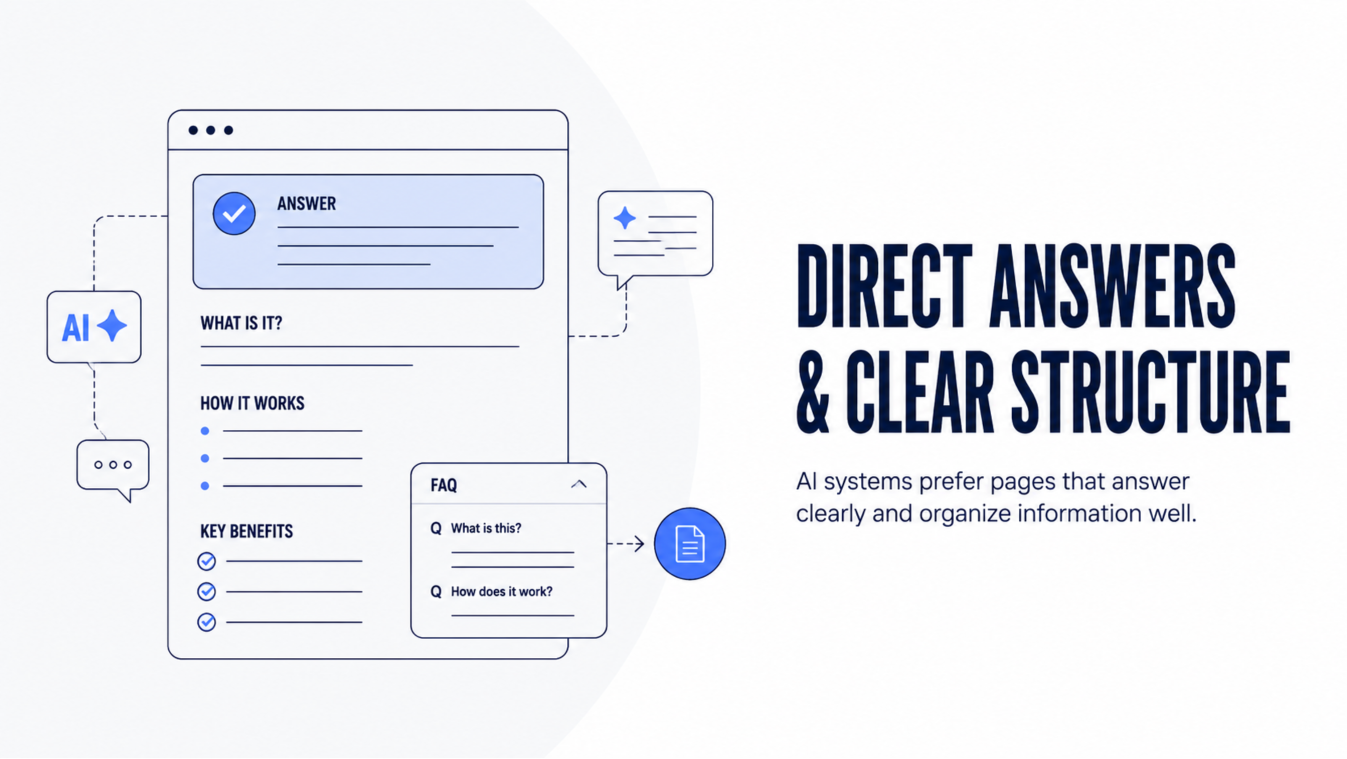
The strongest GEO content usually includes a few important elements.
1. Direct Answers
AI systems prefer content that answers the question clearly.
Do not hide the answer under a long introduction. Start with the main point, then explain the context.
For example, instead of writing a vague opening like:
“GEO has become an important topic in modern digital marketing.”
Write something clearer:
“GEO helps brands improve their visibility in AI-generated answers by making their content easier for AI systems to understand, cite, and recommend.”
The second version is easier to reuse in an AI answer.
2. Statistics and Specific Details
AI systems often need concrete details to make an answer more convincing.
Replace vague language with specific information whenever possible.
Instead of:
“Many companies are using AI search.”
Use:
“B2B buyers increasingly use AI tools to compare vendors, summarize reviews, and build shortlists before visiting company websites.”
Specific details make content more useful. Data, numbers, examples, timelines, and named use cases can all improve the value of a page.
3. Credible Sources
Content becomes stronger when it is supported by reliable sources.
This is especially important in serious topics such as finance, healthcare, law, technology, and business strategy.
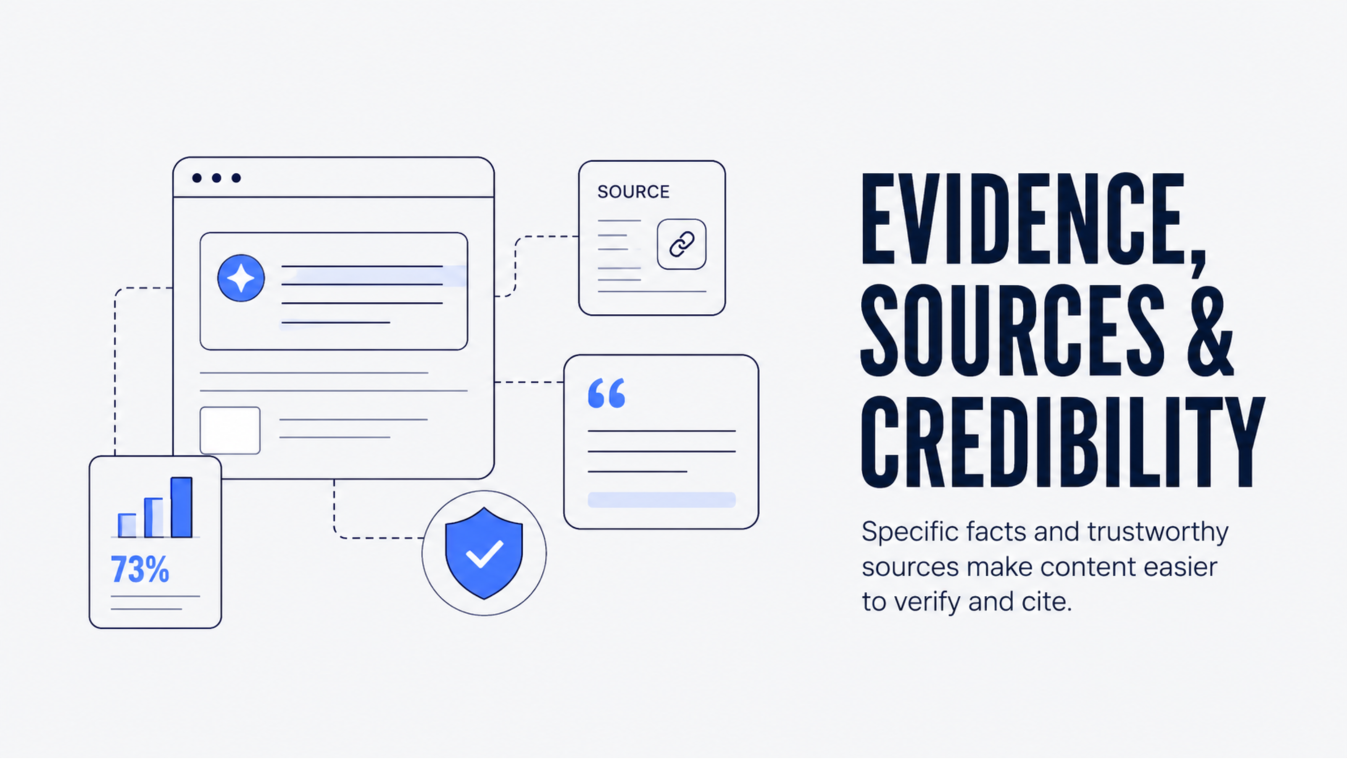
A page that says “this is important” is weaker than a page that explains why and supports the claim with research, reports, standards, expert input, or real examples.
For GEO, sources are not decoration. They help AI systems decide whether the content is safe and useful enough to cite.
4. Clear Structure
AI systems need to extract information quickly.
That is why structure matters.
Use:
Clear headings
Short paragraphs
Lists
Definitions
Comparison sections
FAQs
Examples
Summary points
A well-structured page is easier to understand and easier to cite.
If your content is a wall of text, AI systems may struggle to identify the useful parts.
5. Expert Language Without Confusion
Professional terms can help when they are used correctly.
For technical or B2B topics, industry-specific language can signal expertise. But the content still needs to be understandable.
The best approach is to use expert terms and explain them clearly.
For example:
“Citation visibility means how often your website is used as a source in AI-generated answers.”
This gives the model both the term and the meaning.
6. Strong but Honest Conclusions
AI systems often favor content that provides a clear conclusion.
Weak language can reduce usefulness. Stronger conclusions are easier to summarize.
But this does not mean exaggeration.
Avoid unsupported claims like:
“We are the best GEO agency in the world.”
Use clear and credible positioning instead:
“CiteMark Lab helps brands monitor AI search visibility, identify missing citations, and improve content that AI systems can understand and reference.”
The goal is confidence, not hype.
GEO Content Is Not Just SEO Content
SEO content often focuses on matching keywords and satisfying search intent.
GEO content needs to go further.
It must be useful as source material for an AI-generated answer.
That means every important page should answer three questions:
Can AI understand what this page is about?
Can AI extract a useful answer from this page?
Can AI trust this page enough to cite it?
If the answer is no, the content may be indexed but still invisible in AI search.
A Simple GEO Content Checklist
Before publishing a page, check whether it includes:
A clear answer near the beginning
Specific facts, examples, or data
Credible sources or evidence
Clear headings and short sections
Definitions of important terms
Practical examples
A concise FAQ section
Consistent brand positioning
Internal links to related pages
A clear reason why the page deserves to be cited
This checklist is simple, but it changes how content is written.
The goal is not to publish more words. The goal is to publish content that AI systems can actually use.
Conclusion
AI search does not reward content simply because it exists.
It rewards content that is clear, useful, credible, and easy to turn into an answer.
For brands, this means GEO is not just about technical optimization. It is also about improving the quality of information itself.
If you want your content to be selected by AI, make it easy to understand, easy to verify, and easy to cite.
In AI search, the best content is not always the longest.
It is the content that helps the answer become better.
FAQ
Q: What kind of content gets cited by AI search?
A: AI search is more likely to cite content that provides clear answers, specific details, credible sources, strong structure, and useful examples.
Q: Is keyword optimization still important for GEO?
A: Keywords still help with relevance, but they are not enough. GEO also requires evidence, structure, clarity, and content that AI systems can use directly in answers.
Q: How can brands improve GEO content?
A: Brands should write direct answers, add data and examples, cite credible sources, structure pages clearly, explain expert terms, and keep brand positioning consistent across the site.