
For more than two decades, search optimization was built around keywords.
A user typed a phrase.
A search engine matched that phrase with webpages.
Marketers researched keyword volume, optimized pages, built links, and tracked rankings.
This model created the foundation of modern SEO.
But AI search introduces a different behavior.
Users no longer need to compress their entire problem into a few keywords.
Instead of searching:
“best CRM software”
they may ask:
“What is the best CRM platform for a small consulting company that needs automation but does not have a dedicated sales team?”
The difference is significant.
The user is no longer providing a keyword.
They are providing context, requirements, limitations, and goals.
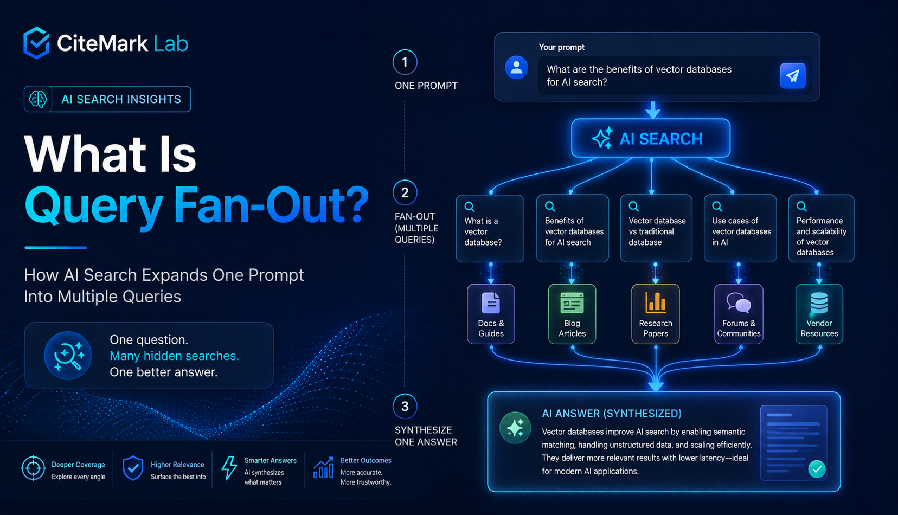
The AI system then has to understand the request, break it into smaller information needs, find relevant sources, and generate a complete answer.
This process is often called query fan-out.
Definition: What Is Query Fan-Out?
Query fan-out refers to the process where an AI search system expands one user prompt into multiple related sub-queries in order to collect enough information to generate an answer.
Instead of treating a prompt as one search request, the AI system analyzes the intent behind the question and explores multiple information paths.
For example, a user asks:
What is the best project management software for a remote design team?
A traditional search engine may focus on the phrase:
“best project management software”
An AI search system may break the question into several hidden questions:
What project management tools support remote collaboration?
Which tools are suitable for creative teams?
Which platforms have strong communication features?
Which solutions are affordable for small teams?
What are the differences between popular options?
What do existing users say about these products?
The final answer is created by combining information from multiple searches.
The user sees one response.
Behind the scenes, the AI may have explored many related information paths.
Why Query Fan-Out Changes Search Behavior
Traditional search relies on the user to perform the research process.
The user chooses keywords.
The user opens different websites.
The user compares information.
The user creates a final conclusion.
AI search changes this relationship.
The AI system takes over much of the research process.
The user provides the problem.
The AI performs the decomposition.
The AI gathers information.
The AI summarizes the answer.
This creates a fundamental change:
In traditional search, users search for information.
In AI search, AI searches for information on behalf of users.
This means businesses are no longer only competing for keyword rankings.
They are competing to become one of the trusted sources used during the AI’s research process.
Query Fan-Out vs Keyword Search
The difference between keyword search and query fan-out can be understood through several dimensions.

Input Style
Traditional keyword search:
“CRM software”
AI prompt search:
“What CRM software is best for a 20-person consulting company that needs automation, reporting, and easy onboarding?”
The second request contains more context.
It tells the AI what problem needs to be solved.
Intent Understanding
In keyword search, the user decides what information to request.
In AI search, the model interprets the user’s intent and determines what information is necessary.
The AI decides:
Which questions need answering
Which sources are relevant
Which comparisons matter
Which details should be included
Search Process
Traditional search:
User → Keyword → Search Results → User Research
AI search:
User → Prompt → Query Expansion → Information Retrieval → AI Answer
The search process moves from user-controlled discovery to AI-assisted discovery.
How Query Fan-Out Works Inside AI Search

Although different AI systems use different architectures, the general process usually follows several stages.
Step 1: Understanding User Intent
The AI first analyzes the meaning behind the prompt.
It identifies:
The topic
The user’s goal
Important constraints
Missing information
Decision factors
For example:
“best accounting software”
and
“best accounting software for a 10-person ecommerce company selling internationally”
represent very different search intentions.
Step 2: Creating Related Sub-Queries
After understanding the request, the AI generates additional questions that help complete the answer.
These sub-queries may involve:
Product comparisons
Pricing information
User reviews
Industry requirements
Technical specifications
Expert opinions
Alternative solutions
The AI is effectively creating a research plan.
Step 3: Retrieving Information
The AI searches across available information sources.
These may include:
Websites
Documentation
News articles
Research papers
Reviews
Industry publications
Public databases
Different AI systems may use different retrieval methods, but the goal is similar:
Find information that helps answer the original prompt.
Step 4: Synthesizing the Final Answer
The AI combines the collected information into a response.
It decides:
Which information is most relevant
Which sources appear trustworthy
Which brands or products should be mentioned
How the answer should be structured
This final stage is where AI visibility becomes important.
A company may have useful content online, but if it is not selected during this process, it may never appear in the final answer.
Why Traditional Keyword Research Cannot Fully Measure AI Search
Traditional SEO tools are designed around measurable keywords.
They answer questions like:
How many people search this term?
What is the ranking difficulty?
Which pages rank today?
How much traffic could this keyword generate?
These measurements remain useful.
However, AI search introduces hidden queries that traditional tools cannot easily capture.
A user may never search:
“ERP migration challenges for manufacturing companies”
But an AI system may internally consider this question when answering:
“What ERP solution is suitable for a factory replacing outdated software?”
The hidden research process creates a new challenge.
Many important AI discovery paths do not have traditional search volume.
They exist because the AI understands the context behind the user’s question.
What Query Fan-Out Means for GEO
Query fan-out changes how companies should approach Generative Engine Optimization.
Traditional SEO often focuses on:
Ranking for keywords
Creating pages around search terms
Increasing organic traffic
GEO requires a broader approach.
Companies need to create content that answers the different questions AI systems may explore.
For example, a cybersecurity company should not only create:
“Cybersecurity Services”
It should also cover:
Common cybersecurity risks
Security compliance requirements
Cloud security challenges
Incident response processes
Security provider comparisons
Industry-specific security needs
Why?
Because AI may use any of these topics when answering a broader customer question.
A brand that only covers one keyword may miss the hidden research paths behind AI answers.
A brand that builds comprehensive topic coverage creates more opportunities to be discovered.
Content Strategies for Query Fan-Out Optimization
1. Build Topic Coverage Instead of Single Keyword Pages
A strong GEO content system should organize information around topics.
For one core topic, companies should cover:
Definitions
Use cases
Comparisons
Alternatives
Pricing questions
Implementation challenges
Common mistakes
Expert insights
This creates more opportunities for AI retrieval.
2. Answer Specific Business Questions
AI users usually ask complete questions.
Content should reflect that behavior.
Instead of only creating:
“What Is CRM?”
companies should also create:
How does CRM help small businesses?
CRM vs ERP: what is the difference?
How long does CRM implementation take?
What should companies evaluate before choosing CRM software?
These questions are closer to real AI search behavior.
3. Create Self-Contained Information Sections
AI systems often extract specific passages rather than entire pages.
A strong content structure includes:
Clear definitions
Direct answers
Short explanations
Comparison tables
Step-by-step frameworks
FAQs
Each section should provide enough context to stand alone.
4. Strengthen Brand Authority Across Sources
Query fan-out means AI may discover information about a brand from many places.
Important sources may include:
Company websites
Industry publications
Customer reviews
Partner websites
Research reports
Expert interviews
A consistent information footprint helps AI systems better understand the brand.
A Practical Example
Imagine a company called DataFlow, which provides analytics software for retail businesses.
The company wants to appear when users ask AI:
“What is the best analytics platform for growing ecommerce brands?”
A traditional SEO strategy might create a page targeting:
“ecommerce analytics software”
However, AI may explore many additional questions:
Which analytics tools integrate with Shopify?
What metrics matter for ecommerce growth?
Which platforms support customer segmentation?
What are affordable analytics solutions for small brands?
How do different analytics tools compare?
If DataFlow only has one product page, it may miss many discovery paths.
A GEO-focused strategy would build a broader knowledge ecosystem:
Ecommerce analytics guide
Analytics platform comparison
Customer segmentation tutorial
Retail data strategy report
Integration guide
Customer success stories
Now, regardless of which hidden query the AI explores, DataFlow has more opportunities to become part of the answer.
The company is no longer optimizing for one keyword.
It is building a knowledge footprint around a topic.
The Future of Search: From Keywords to Questions
Query fan-out represents one of the biggest changes brought by AI search.
The future of discovery will not be based only on the keywords users type.
It will depend on the questions AI systems ask internally while solving user problems.
For businesses, this means the goal is changing.
The objective is no longer simply:
“Rank for this keyword.”
The new objective is:
“Become the trusted source AI uses when answering this category of questions.”
That requires deeper content, stronger authority signals, and a more complete understanding of user intent.
Query fan-out is not replacing SEO.
It is expanding the definition of search itself.
Frequently Asked Questions
What is query fan-out in AI search?
Query fan-out is the process where AI systems expand one user prompt into multiple related searches to collect information and generate a more complete answer.
How is query fan-out different from keyword search?
Keyword search relies on users choosing search terms. Query fan-out allows AI systems to interpret a complete request, create related queries, and gather information automatically.
Why does query fan-out matter for GEO?
Because AI may discover and cite content through hidden sub-queries that traditional keyword tools cannot identify. GEO requires businesses to cover broader topics and user questions.
How can companies optimize for query fan-out?
Companies can optimize by creating comprehensive topic coverage, answering specific user questions, improving content structure, and building authority across multiple sources.
Does query fan-out replace SEO?
No. SEO remains important, but AI search introduces a new layer where brands need to optimize for questions, context, and AI-driven discovery.