
For years, brand visibility was relatively easy to describe.
If your website ranked well on Google, appeared in search results, earned traffic, and converted visitors, your marketing team could say the brand was visible.
That model still matters.
But it no longer explains the full picture.
Today, a potential buyer may open ChatGPT, Perplexity, Gemini, Claude, or Google AI Overviews and ask:
“What are the best platforms for improving AI search visibility?”
The AI may generate a short list of recommended brands, summarize their strengths, mention competitors, and cite several sources.
Your website may never receive a visit.
Your analytics dashboard may record nothing.
But a brand decision has already started.
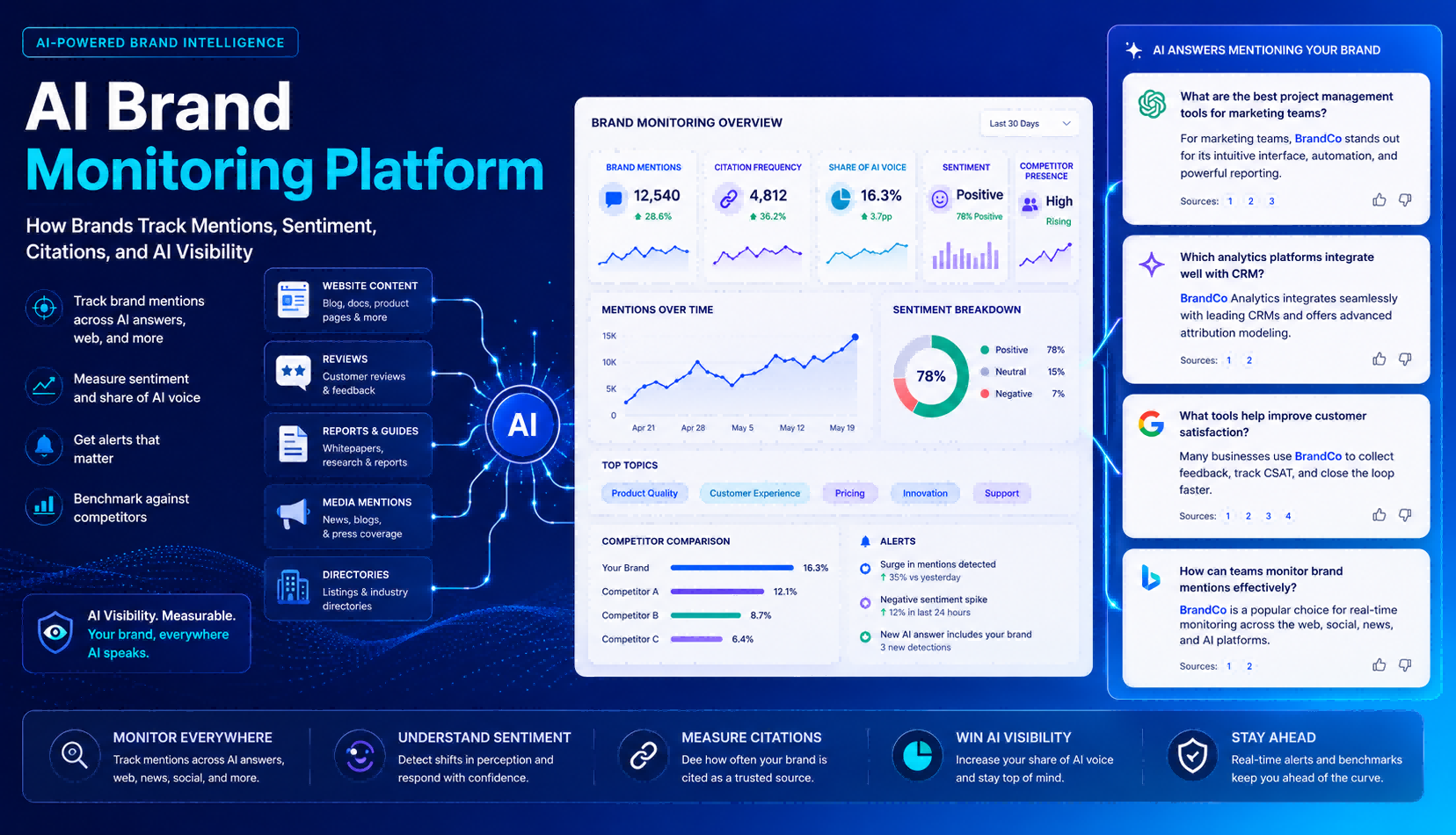
This is the gap an AI brand monitoring platform is designed to address.
An AI brand monitoring platform tracks how a brand appears, disappears, or is described inside AI-generated answers. Instead of measuring only webpage rankings or search traffic, it measures whether AI systems recognize the brand, mention it in relevant answers, describe it accurately, and cite trustworthy sources connected to it.
In simple terms:
Traditional SEO tools track where your links appear.
AI brand monitoring platforms track what AI systems say about your brand.
Why AI Brand Monitoring Exists
AI search changes the object of visibility.
In traditional search, the main visibility unit was the webpage.
A user searched a keyword, saw a list of results, clicked a link, and visited a website.
In AI search, the main visibility unit is often the entity.
The AI system may not present ten blue links. It may synthesize an answer around companies, products, categories, experts, and sources.
That means the question is no longer only:
“Where does our page rank?”
It becomes:
“Does AI understand who we are?”
“Does AI include us when users ask about our category?”
“Does AI describe us in the way we want to be understood?”
“Does AI trust our website or third-party sources when forming an answer?”
This is a major shift for marketing teams.
A brand may still rank well in Google search results but remain invisible inside AI-generated answers.
Another brand may have less search traffic but appear frequently in AI answers because it has clearer positioning, stronger third-party validation, better structured content, and more consistent public information.
AI brand monitoring exists because traditional dashboards were not built to observe this new layer of discovery.
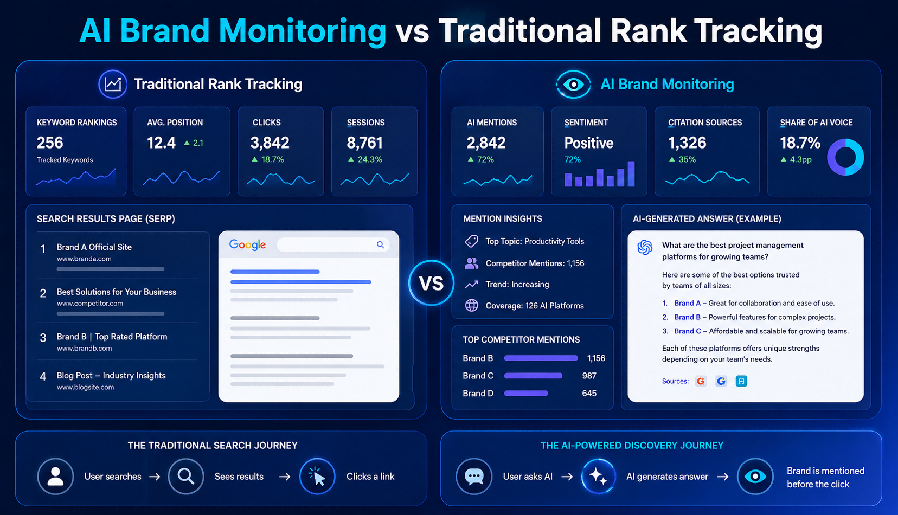
AI Brand Monitoring vs Traditional SEO Rank Tracking
An SEO rank tracker measures where a webpage appears for a keyword.
An AI brand monitoring platform measures how a brand appears inside generated answers.
These are related, but they are not the same.
A rank tracker is usually built around keywords, URLs, ranking positions, search volume, and click-through opportunities.
An AI brand monitoring system is built around prompts, entities, mentions, citations, sentiment, competitors, and source attribution.
For example, a traditional rank tracker might tell you:
Your page ranks position 4 for “best project management software.”
An AI brand monitoring platform might tell you:
Your brand appears in 18% of AI answers for project management software queries, but competitors are mentioned more often in enterprise-related prompts. AI systems describe your product as suitable for small teams, while your website positions it as an enterprise solution.
The second insight is more complex, but it is also more useful in the AI search environment.
AI-generated answers do not behave like static search result pages.
They can vary by prompt wording, platform, model version, context, geography, retrieval source, and time.
That is why AI brand monitoring focuses less on a single fixed position and more on recurring visibility patterns.
What an AI Brand Monitoring Platform Tracks
A useful AI brand monitoring platform does not only answer whether a brand appeared.
It should help explain how, where, and why the brand appeared.
Most platforms track several core dimensions.
1. Visibility Rate
Visibility rate measures how often a brand appears across a defined set of relevant AI prompts.
For example, if a company tests 100 category-related prompts and the brand appears in 27 AI-generated answers, its visibility rate for that prompt set is 27%.
This metric helps answer a basic question:
Is AI seeing the brand at all?
Visibility rate is especially important for non-branded prompts, such as:
Best tools for remote collaboration
Top GEO agencies for SaaS companies
CRM platforms for small consulting firms
Cybersecurity providers for mid-sized businesses
Best alternatives to a known competitor
These prompts often reflect real buyer discovery behavior.
2. Brand Position
Brand position measures where and how prominently the brand appears inside an AI answer.
In traditional SEO, position often means numerical ranking.
In AI answers, position is more fluid.
A brand may appear as the first recommendation, appear in a secondary list, appear only as an alternative, or be mentioned in passing.
For decision-making queries, prominence matters.
A brand that appears as the primary recommendation is not in the same position as a brand buried near the end of an answer.
AI brand monitoring should therefore track not only whether a brand appears, but how strongly it appears.
3. Sentiment and Framing
A brand mention is not always positive.
AI may describe a company as a category leader, a budget-friendly option, a niche tool, an enterprise provider, a legacy vendor, or a lightweight alternative.
Sometimes this description matches the brand’s desired positioning.
Sometimes it does not.
Sentiment and framing analysis helps companies understand whether AI systems are representing the brand accurately.
For example:
A premium consulting firm may not want to be described as a low-cost provider.
A product built for enterprise teams may not want to be framed as a tool for freelancers.
A company that recently changed its focus may not want AI systems to repeat outdated descriptions.
This makes AI brand monitoring useful not only for visibility, but also for positioning governance.
4. Share of AI Voice
Share of AI voice compares one brand’s presence against competitors inside AI-generated answers.
This is important because AI search is competitive.
If users ask for the best companies in your category, the AI may mention three to five options.
The question is not simply whether your brand appears.
The question is whether your brand appears more often, more prominently, and more favorably than alternatives.
Share of AI voice helps marketing teams understand whether they are gaining or losing influence in AI-mediated discovery.
5. Citation Frequency
Citation frequency measures how often AI systems cite or reference a brand’s website, content, or related sources.
This is especially important in AI products that display citations, such as Perplexity or Google AI Overviews.
If a competitor is frequently cited and your brand is not, that may indicate a content authority gap.
If AI mentions your brand but cites third-party sources instead of your own website, that may indicate that external sources are shaping your brand narrative more strongly than your owned content.
Citation frequency helps answer:
Which sources does AI trust when talking about our category?
6. Source Attribution
Source attribution identifies the domains, URLs, publications, directories, review platforms, communities, or documents AI systems rely on when forming answers.
This is one of the most actionable parts of AI brand monitoring.
If a competitor appears in AI answers because of a strong comparison article, review profile, analyst mention, or industry report, that information can guide your content and authority strategy.
Source attribution turns AI visibility from a mystery into a set of fixable signals.
Why Perplexity Monitoring Is Often Treated Separately
Perplexity is often discussed separately in AI brand monitoring because its answer experience is strongly citation-driven.
Unlike some AI assistants that generate answers without always showing source links, Perplexity typically displays the sources behind its responses.
This makes it useful for understanding how AI search systems select and validate information.
When a brand appears in Perplexity, teams can often inspect which sources supported the answer.
When a competitor appears instead, teams can identify which pages, publications, or third-party references helped that competitor earn visibility.
This source transparency makes Perplexity monitoring valuable for three reasons.
First, it reveals which domains influence AI-generated answers.
Second, it shows how quickly citations can change when new content appears.
Third, it helps teams connect visibility outcomes to specific source pages.
However, Perplexity visibility can also be volatile.
Because it relies heavily on live or recent sources, results may shift as new pages are published, old pages lose relevance, or competing sources become stronger.
This is why ongoing monitoring is more useful than a one-time manual check.
How AI Brand Monitoring Works
A serious AI brand monitoring process usually follows a repeatable workflow.
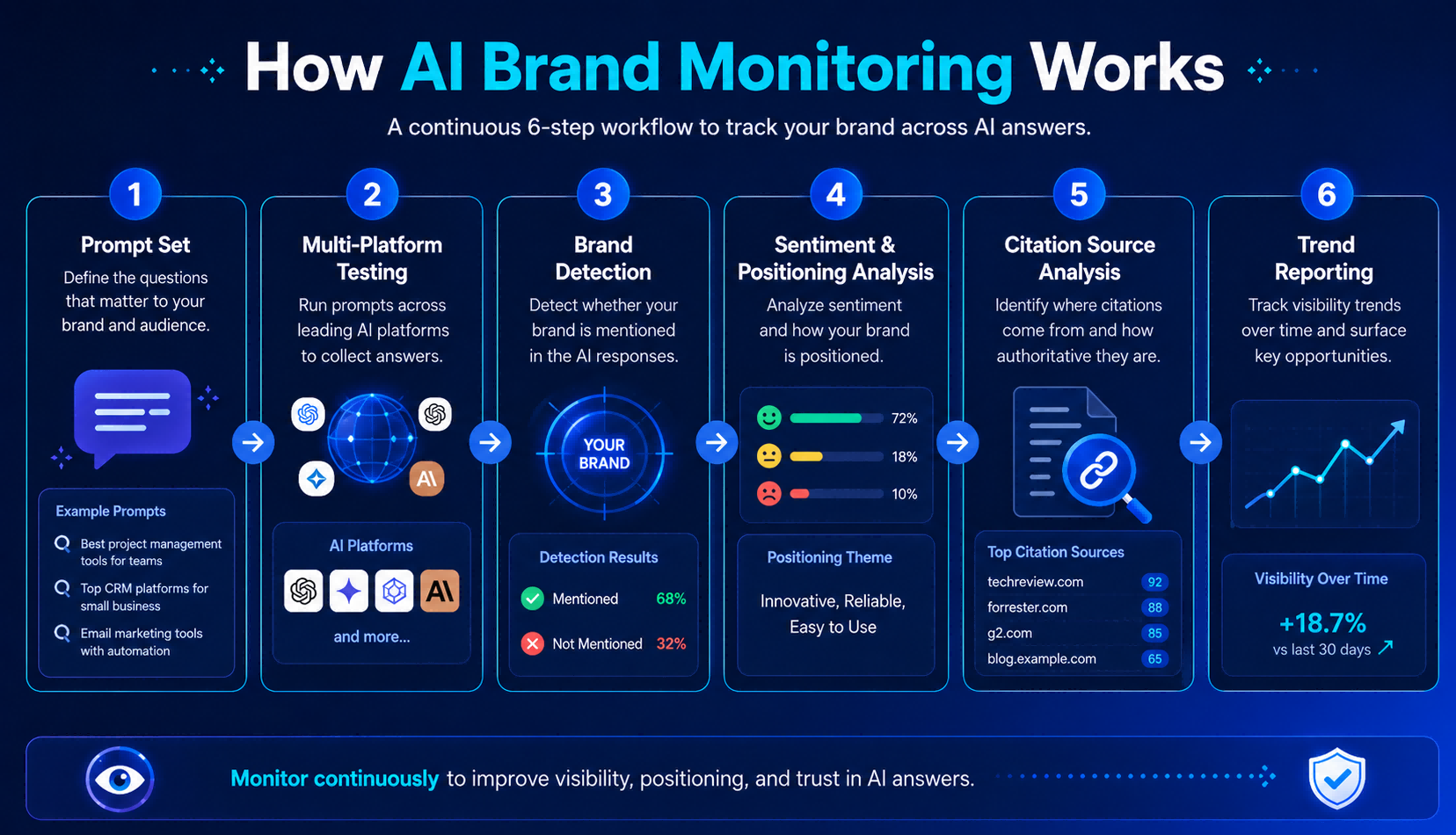
Step 1: Build a Prompt Set
The process starts by building a set of prompts that reflect real user behavior.
These prompts should include branded, non-branded, category, comparison, alternative, and problem-solving questions.
Examples include:
What are the best AI visibility platforms?
Which GEO agencies are suitable for B2B SaaS companies?
What tools help brands monitor AI search visibility?
What are the best alternatives to [competitor]?
Which companies are trusted in AI search optimization?
The quality of the prompt set matters because the monitoring results depend on what is being tested.
Step 2: Run Prompts Across AI Platforms
The same prompts should be tested across multiple AI systems.
Different platforms may produce different answers.
A brand may appear in ChatGPT but not in Gemini.
It may be cited by Perplexity but ignored by Google AI Overviews.
It may appear for broad category prompts but disappear from comparison prompts.
Multi-platform testing helps avoid overconfidence based on a single AI engine.
Step 3: Detect Brand Mentions and Competitors
After responses are collected, the system identifies which brands appear.
This includes the company being monitored and its competitors.
The system should detect whether the brand is recommended, listed, compared, cited, or only briefly mentioned.
Step 4: Analyze Sentiment and Positioning
Next, the platform analyzes how the brand is described.
This step looks at tone, context, strengths, weaknesses, category association, and positioning accuracy.
For example, AI may describe a brand as:
Best for enterprise teams
Suitable for small businesses
Strong in analytics
Limited in integrations
Known for affordability
Strong in security and compliance
These descriptions can influence how buyers perceive the brand before visiting the website.
Step 5: Identify Citation Sources
The platform then reviews which sources support the AI answer.
This may include owned content, third-party review sites, media articles, directories, research reports, documentation, forums, or competitor pages.
Citation analysis is essential because it shows where AI is getting its information.
Step 6: Track Changes Over Time
AI answers are not fixed.
Models update.
Retrieval systems change.
Competitors publish new content.
News and reviews appear.
Old sources become outdated.
For that reason, AI brand monitoring should track trends over time rather than rely on one snapshot.
A monthly or weekly view can reveal whether a brand’s AI visibility is improving, declining, or shifting across platforms.
What Makes a Good AI Brand Monitoring Platform?
Not all AI brand monitoring tools are equal.
A useful platform should have several capabilities.
Multi-Engine Coverage
A platform should monitor more than one AI system.
Tracking only one platform creates an incomplete view.
At minimum, companies may want to monitor ChatGPT, Perplexity, Google AI Overviews, Gemini, Claude, and other tools relevant to their market.
Prompt-Level Granularity
The platform should allow teams to define and organize prompt sets.
Generic keyword tracking is not enough because AI search behavior is conversational.
Prompt-level tracking helps teams measure visibility around actual customer questions.
Competitor Benchmarking
AI visibility only makes sense in context.
A brand needs to know not only whether it appears, but also which competitors appear more often, more prominently, or with stronger sentiment.
Sentiment and Positioning Analysis
The platform should evaluate how the brand is described.
A mention without context is incomplete.
Source Attribution
The platform should show which sources AI systems rely on.
This helps teams identify content gaps, citation gaps, and external authority opportunities.
Trend Reporting
A good platform should show changes over time.
One-time checks are useful for diagnosis, but ongoing reporting is needed for strategy.
Actionable Recommendations
The best monitoring systems do not stop at reporting.
They help teams decide what to do next, such as updating product pages, creating comparison content, improving schema, strengthening third-party profiles, or publishing more evidence-based resources.
Common Mistakes in AI Brand Monitoring
Many companies begin monitoring AI visibility but make mistakes that distort the results.
Checking Only the Brand Name
If you only ask AI systems about your own brand, you will miss how buyers actually discover solutions.
Most users begin with category, problem, or comparison questions.
Non-branded prompts are essential.
Treating One AI Answer as Proof
A single answer from one AI platform is not enough evidence.
AI responses can vary.
Reliable monitoring requires repeated testing across a structured prompt set.
Measuring Visibility Without Sentiment
A brand can be visible and still be positioned poorly.
AI may mention the company but describe it as outdated, limited, expensive, or unsuitable for the target audience.
Sentiment and framing matter.
Ignoring Citation Sources
If teams do not understand which sources AI relies on, they cannot improve visibility systematically.
Citation analysis is what turns monitoring into strategy.
Assuming SEO Rankings Guarantee AI Mentions
Strong Google rankings can help, but they do not guarantee AI visibility.
AI systems may rely on different sources, interpret authority differently, or prefer content that is more directly answer-ready.
Example: How AI Brand Monitoring Changes Strategy
Imagine a fictional company called ClearDesk.
ClearDesk sells customer support software for mid-sized SaaS companies.
The company has decent SEO performance. Its website ranks for several product-related keywords, and organic traffic is stable.
However, the marketing team notices that inbound leads from comparison and recommendation searches are slowing down.
They begin testing AI prompts such as:
Best customer support tools for B2B SaaS companies
Alternatives to Zendesk for mid-sized SaaS teams
AI customer support software for growing SaaS companies
What tools help SaaS companies reduce support tickets?
The results reveal a problem.
ClearDesk appears in only a small percentage of AI answers.
When it does appear, it is described as a simple helpdesk tool rather than an AI support automation platform.
Competitors are cited more often, especially from third-party review sites and comparison articles.
This changes the team’s strategy.
Instead of publishing more generic blog posts, ClearDesk focuses on five actions:
First, it updates its core product pages to clarify its AI automation capabilities.
Second, it creates comparison content for high-intent prompts where competitors currently win.
Third, it rewrites customer case studies to include measurable outcomes, such as ticket deflection rate and response time improvement.
Fourth, it improves public profiles on review platforms and software directories.
Fifth, it monitors the same prompt set every month to see whether AI descriptions improve.
Over time, ClearDesk begins appearing more often in AI answers for SaaS support automation queries.
More importantly, the way AI describes the brand becomes more accurate.
This is the real value of AI brand monitoring.
It does not only show whether a brand is visible.
It shows what needs to change for the brand to become more understandable, credible, and recommendable.
Conclusion
An AI brand monitoring platform helps companies measure a form of visibility that traditional SEO tools cannot fully capture.
As more users rely on AI systems to compare vendors, evaluate products, and make decisions, brand discovery increasingly happens inside generated answers.
That means companies need to know whether AI systems mention them, how they describe them, which competitors appear alongside them, and which sources shape those answers.
AI brand monitoring is not a replacement for SEO analytics.
It is a new measurement layer for the AI search environment.
The companies that benefit most will be those that use monitoring not as a passive dashboard, but as a feedback loop for improving content, positioning, authority, and trust.
In AI search, the question is no longer only whether users can find your website.
The question is whether AI systems understand your brand well enough to recommend it.
Frequently Asked Questions
What is an AI brand monitoring platform?
An AI brand monitoring platform tracks how a brand appears in AI-generated answers. It measures mentions, sentiment, citations, competitor presence, source attribution, and visibility trends across AI search platforms.
How is AI brand monitoring different from SEO rank tracking?
SEO rank tracking measures where a webpage appears in search results. AI brand monitoring measures whether AI systems mention, describe, recommend, or cite a brand inside generated answers.
Why does AI brand monitoring matter?
It matters because users increasingly discover brands through AI-generated answers before visiting websites. If a brand is absent or inaccurately described in those answers, traditional web analytics may not detect the problem.
Which metrics should companies track?
Important metrics include visibility rate, brand position, sentiment, share of AI voice, citation frequency, source attribution, and prompt-level competitive gaps.
Can AI brand visibility be improved?
Yes. Companies can improve AI brand visibility by strengthening content structure, clarifying positioning, earning credible third-party mentions, publishing citation-worthy resources, and monitoring AI answer trends over time.