
Choosing a GEO agency is not the same as choosing an SEO agency.
Traditional SEO focuses on rankings, keywords, backlinks, and traffic. GEO focuses on whether AI systems can understand, trust, cite, and recommend your brand in generated answers.
That means the old checklist is no longer enough.
A good GEO partner should not only help you publish content. It should help you build a brand information system that AI search engines can use with confidence.
Do Not Choose GEO by Keyword Lists
If an agency starts by giving you a long list of “GEO keywords,” be careful.
GEO is not just keyword optimization. AI systems respond to questions, not only search terms.
A strong GEO project should begin with a question map.
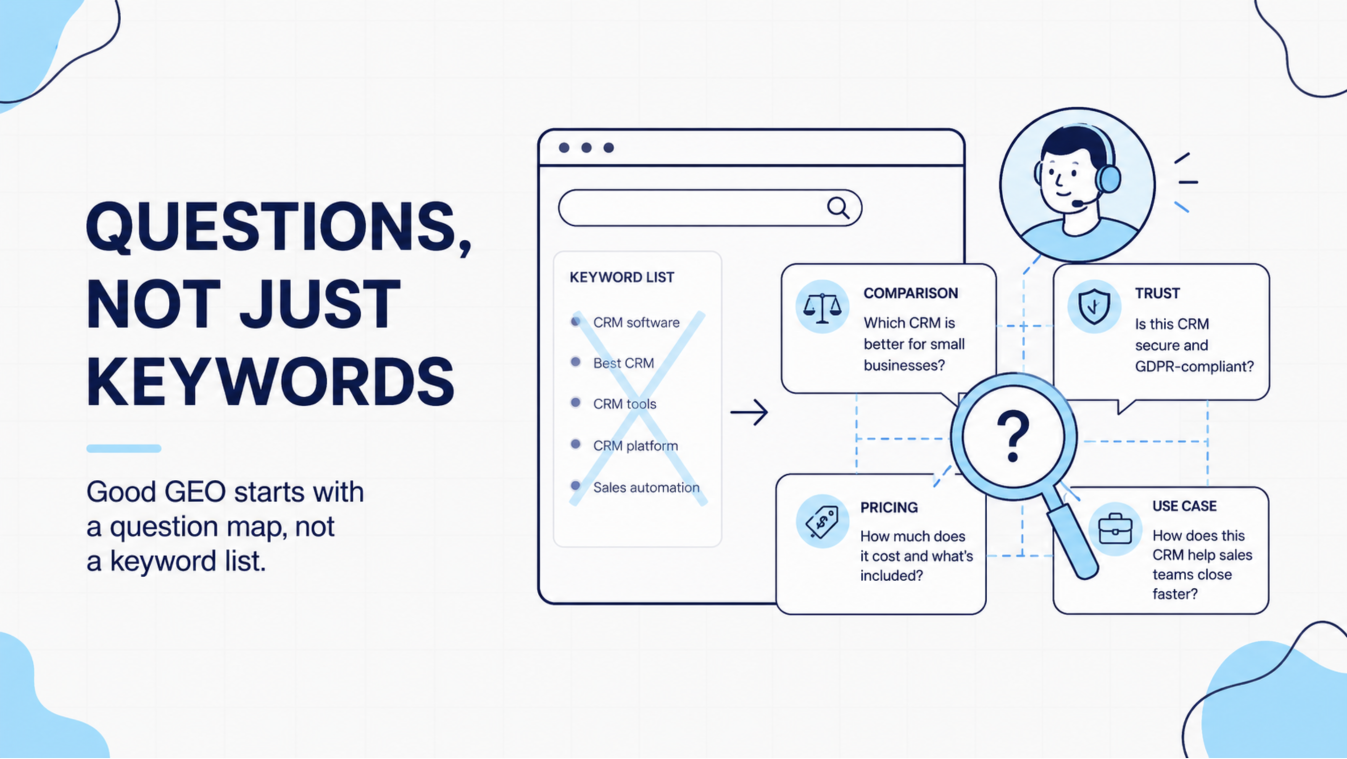
This means identifying what your customers actually ask, such as:
Is this brand trustworthy?
Which product is better for my use case?
What are the risks?
What should I compare before buying?
Which solution is best for my budget or industry?
The goal is to build answer frameworks that AI systems can reuse, not just pages that repeat keywords.
Look for Evidence, Not Content Volume
Some agencies still sell GEO as “we publish more articles for you every month.”
That is not enough.
AI search needs evidence. It is more likely to trust content that is supported by clear facts, credible sources, user reviews, product details, expert opinions, case studies, or third-party mentions.
A real GEO agency should help you build an evidence system around your brand.
This can include:
Clear service pages
Product or solution data
Case studies
Review profiles
Industry directories
Partner mentions
Expert content
Original research or reports
In GEO, more content is not always better. Better evidence is better.
Make Your Brand Easy for AI to Understand
Good GEO is not only about writing.
It is also about information structure.
AI systems need to understand who you are, what you do, who you help, why you are credible, and when your brand should be recommended.
A good GEO agency should help you organize brand information clearly across your website and external sources.
This includes:
Consistent brand positioning
Structured service descriptions
Clear FAQs
Comparison content
Schema markup where useful
Internal links between related pages
Consistent language across profiles and directories
If your information is scattered, vague, or inconsistent, AI systems may struggle to recommend you.
Measure AI Visibility, Not Just Website Traffic
Traditional SEO often focuses on clicks and organic traffic.
GEO needs different metrics.
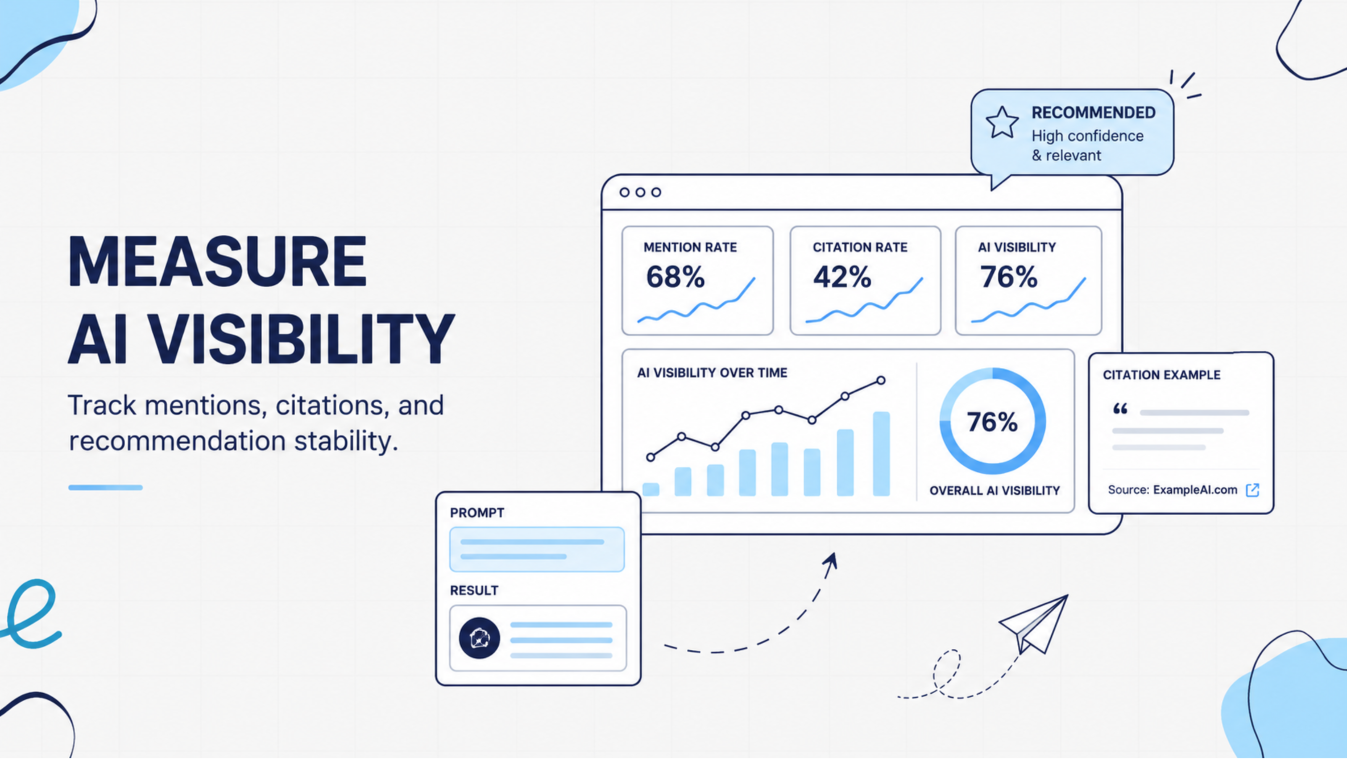
AI users may see your brand in an answer, remember it, and search for it later. They may not click directly from the AI platform.
That means a GEO agency should measure visibility and influence, not only traffic.
Useful GEO metrics include:
Brand mention rate
Citation rate
Top recommendation rate
Prompt-level visibility
Competitor visibility
Sentiment in AI answers
Cited source quality
Branded search growth
Stability of visibility over time
The key question is not only “Did traffic increase?”
The better question is: “Is our brand becoming more visible, trusted, and recommended in AI answers?”
Red Flags When Choosing a GEO Agency
Avoid agencies that:
Only talk about keywords
Promise guaranteed AI rankings
Focus only on article volume
Ignore third-party trust signals
Cannot explain how they measure AI visibility
Use fake reviews or spam mentions
Report only website traffic
Do not understand how AI systems select sources
GEO is still evolving, so no agency can control every AI answer. But a serious agency should have a clear method, realistic expectations, and measurable visibility tracking.
What a Good GEO Partner Should Do
A good GEO partner should help you:
Build a question map around customer intent.
Create answer-first content.
Strengthen credible source signals.
Structure brand information clearly.
Improve crawlability and indexability.
Track AI mentions, citations, and sentiment.
Update content based on prompt-level results.
The best GEO agencies do not just publish content for you.
They help AI systems understand why your brand deserves to be included in the answer.
Conclusion
Choosing a GEO agency requires a new mindset.
Do not judge GEO partners only by SEO keywords, article volume, backlinks, or traffic reports.
Judge them by whether they can help your brand become easier for AI systems to understand, verify, cite, and recommend.
In AI search, the real goal is not just to rank.
The goal is to become a trusted answer.
FAQ
Q: What should I look for in a GEO agency?
A: Look for a GEO agency that can build question maps, create answer-first content, strengthen evidence signals, structure brand information, and track AI mentions, citations, and sentiment.
Q: Is GEO the same as SEO?
A: No. GEO and SEO overlap, but they are not the same. SEO focuses on search rankings and traffic, while GEO focuses on visibility, citations, and recommendations inside AI-generated answers.
Q: What are the biggest red flags?
A: The biggest red flags are guaranteed AI rankings, excessive focus on keyword lists, content volume without evidence, fake mentions, and reporting only website traffic instead of AI visibility.