
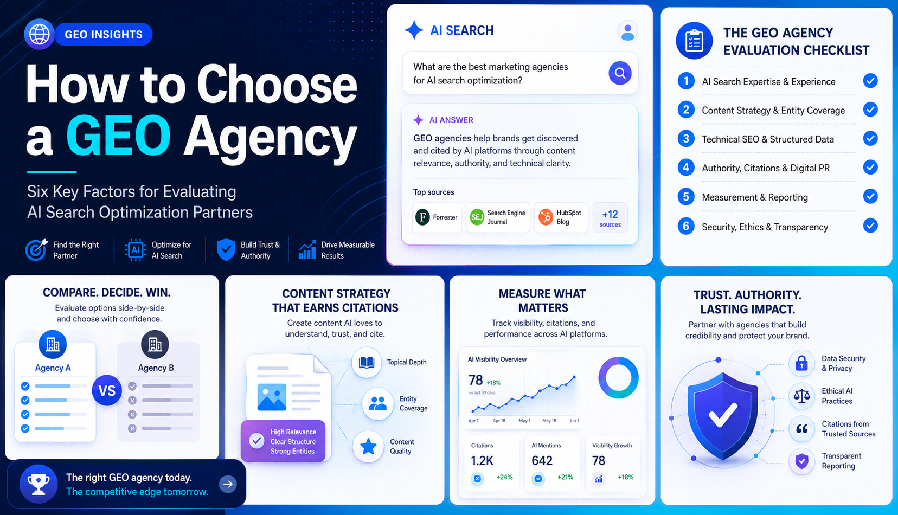
As AI search becomes part of the way people discover brands, products, and services, more companies are starting to ask a new question:
How do we make our brand more visible in AI-generated answers?
This question has created growing demand for GEO agencies.
GEO, or Generative Engine Optimization, focuses on improving a company’s visibility, relevance, and citation potential inside AI systems such as ChatGPT, Gemini, Perplexity, Claude, and other AI-powered search experiences.
But choosing a GEO agency is not easy.
The market is still young. Service definitions vary widely. Some providers focus on content. Some focus on technical monitoring. Some position GEO as an extension of SEO. Others treat it as a broader brand authority and knowledge strategy.
For companies evaluating potential partners, the challenge is not simply finding an agency that claims to “do GEO.”
The real challenge is identifying which partner can understand your business, build trustworthy content systems, measure AI visibility properly, and adapt as AI search platforms continue to evolve.
This guide outlines six key factors companies should consider when choosing a GEO agency.
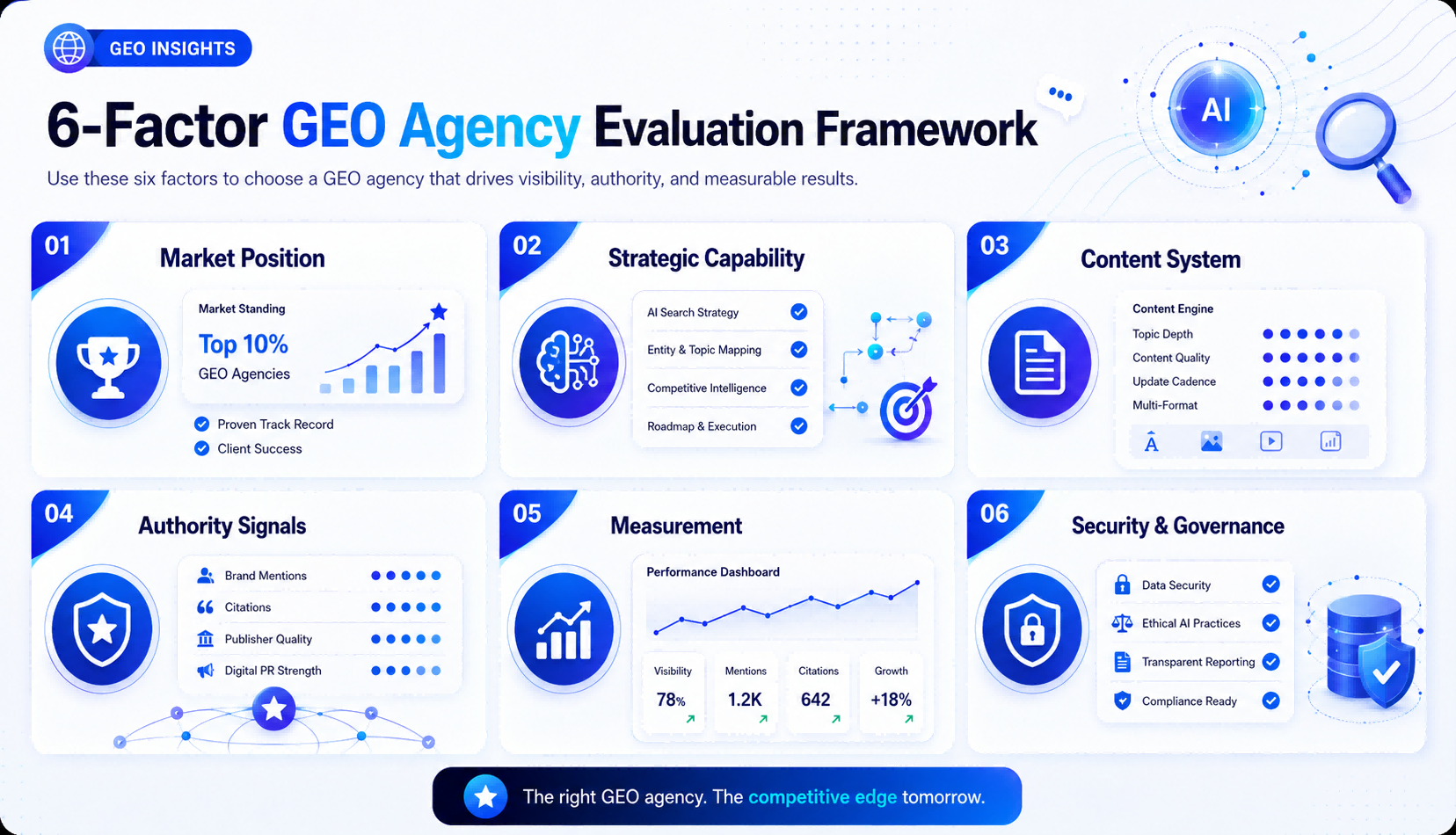
1. Market Position: Understand What Type of GEO Agency You Need
Before evaluating specific agencies, companies should first understand the different types of GEO service providers in the market.
Not every GEO agency solves the same problem.
Some agencies are strategy-led. They help brands define positioning, map user intent, and build long-term AI visibility systems.
Some are content-led. They focus on producing AI-friendly articles, landing pages, comparison content, and knowledge base materials.
Some are technology-led. They provide tools for AI visibility tracking, citation monitoring, prompt testing, and competitive analysis.
Some are SEO-led. They extend traditional SEO services into AI search by optimizing existing content for generative engines.
Some are PR-led. They focus on third-party mentions, thought leadership, media coverage, and external authority signals.
None of these types is automatically better than the others.
The right choice depends on the company’s stage, budget, category, and business objective.
A SaaS company trying to appear in AI recommendations may need a mix of content strategy and citation tracking.
A professional services firm may need stronger thought leadership and expert content.
An enterprise brand may need a more complex system involving technical audits, content governance, reputation management, and cross-platform monitoring.
The first step is not asking, “Which GEO agency is the best?”
A better question is:
“Which type of GEO partner matches our current problem?”
2. Strategic Capability: Can the Agency Understand User Intent?
GEO is not only about publishing content.
At its core, GEO is about understanding what users ask AI systems and why they ask those questions.
A strong GEO agency should be able to analyze user intent at multiple levels.
For example, when someone asks:
“What is the best CRM for a small consulting firm?”
they are not only looking for a list of CRM tools.
They may also be asking:
Which CRM is affordable?
Which one is easy to implement?
Which one works for small teams?
Which one has credible reviews?
Which one is suitable for client relationship management rather than enterprise sales?
A weak GEO strategy would simply create an article targeting the keyword “best CRM.”
A stronger GEO strategy would build content around the real decision-making context behind the query.
When evaluating an agency, companies should ask:
How does the agency research AI search queries?
Can it map user intent across different buying stages?
Does it understand comparison, recommendation, and problem-solving queries?
Can it translate user questions into a structured content roadmap?
If an agency cannot explain user intent clearly, it will struggle to improve AI visibility in a meaningful way.
3. Content System: Can the Agency Build AI-Readable Knowledge Assets?
AI systems rely on information that can be retrieved, interpreted, and synthesized.
That means content structure matters.
A GEO agency should not only write blog posts. It should help build a knowledge system that makes the brand easier for AI systems to understand.
A strong GEO content system may include:
Definition articles
Use case pages
Comparison guides
Industry explainers
Buyer guides
Case studies
FAQ pages
Expert opinion articles
Data reports
Product and service explainers
The goal is to make the company’s expertise clear and verifiable.
For example, a cybersecurity company should not only have a page saying it provides “enterprise security solutions.”
It should also publish useful content around risk assessment, incident response, cloud security, compliance requirements, threat trends, vendor selection, and implementation challenges.
This helps AI systems associate the company with a broader topic area.
When choosing a GEO agency, companies should evaluate whether the agency can design a complete content architecture rather than produce isolated articles.
Useful questions include:
Does the agency understand topical authority?
Can it create a content structure around entities and use cases?
Does it write for both human readers and AI retrieval systems?
Can it balance educational content, decision content, and proof-based content?
Does it avoid thin, generic, AI-generated articles?
In GEO, content volume alone is not enough.
The content must be useful, structured, and credible.
4. Authority Signals: Can the Agency Help Build Trust Beyond Your Website?
One of the biggest misconceptions about GEO is that everything happens on the company’s own website.
In reality, AI systems may evaluate information from many types of sources.
A brand’s official website matters, but it is only one part of the picture.
External signals can also influence how a brand is understood:
Media mentions
Industry directories
Review platforms
Partner websites
Customer stories
Research reports
Community discussions
Expert interviews
Conference pages
Public documentation
If a company only makes claims on its own website, those claims may be treated cautiously.
If the same claims are supported by credible third-party sources, the brand becomes easier to verify.
A good GEO agency should understand this.
It should help companies build a wider knowledge footprint, not just a larger blog.
This does not mean chasing low-quality backlinks or mass publishing promotional articles.
It means building consistent, useful, and verifiable references across the web.
When evaluating an agency, companies should ask:
Does the agency have a plan for third-party authority building?
Can it help create citation-worthy assets?
Does it understand digital PR, expert positioning, and external content distribution?
Can it help maintain consistency across different brand profiles and public sources?
AI visibility is closely connected to trust.
And trust is rarely built in one place.
5. Measurement: Can the Agency Prove Whether GEO Is Working?
GEO measurement is still developing.
Unlike traditional SEO, where rankings, impressions, clicks, and backlinks are relatively established metrics, AI visibility is more complex.
A company may need to track different signals across multiple AI platforms.
Common GEO metrics include:
AI mention frequency
Citation frequency
Share of AI visibility
Presence in recommendation queries
Brand sentiment in AI-generated answers
Competitor comparison visibility
AI referral traffic
Branded search growth
Content inclusion in AI answers
A serious GEO agency should be able to explain what it measures, how it measures it, and what limitations exist.
Companies should be careful with vague claims such as:
“We will improve your AI ranking.”
AI systems do not always operate with fixed rankings in the same way search engines do.
The same prompt may produce different answers depending on context, geography, model version, retrieval behavior, personalization, and real-time web access.
A stronger agency will explain GEO measurement as a monitoring and evidence-building process.
Before choosing a partner, ask:
Which AI platforms will be monitored?
Which prompts or query categories will be tracked?
How often will visibility be measured?
How will competitor visibility be compared?
How will results be reported?
What counts as a meaningful improvement?
If an agency cannot define success clearly, it will be difficult to judge performance later.
6. Pricing, Governance, and Data Security: Is the Partnership Sustainable?
GEO is not usually a one-time project.
Because AI search systems change frequently, companies need ongoing monitoring, content updates, and strategy refinement.
That makes pricing and governance important.
Common pricing models may include:
Monthly retainers
Project-based audits
Content packages
Platform monitoring subscriptions
Consulting engagements
Performance-linked components
Each model has advantages and risks.
A short-term project may be useful for an initial audit or content roadmap.
A monthly retainer may be better for ongoing execution and monitoring.
A performance-based model may reduce upfront risk, but it requires very clear definitions of what “performance” means.
Companies should avoid agreements where deliverables are unclear.
A good GEO agreement should define:
Scope of work
Content deliverables
Monitoring frequency
Reporting format
Target platforms
Approval process
Data access requirements
Confidentiality terms
Ownership of produced content
Exit terms
Data security also matters.
A GEO agency may need access to analytics data, content systems, customer insights, product information, or internal marketing documents.
Before cooperation begins, companies should clarify:
What data the agency needs
How that data will be stored
Who can access it
Whether sensitive information will be used in public content
How confidential materials will be protected
Whether the agency uses third-party AI tools in its workflow
GEO work often involves brand knowledge.
That knowledge should be handled carefully.
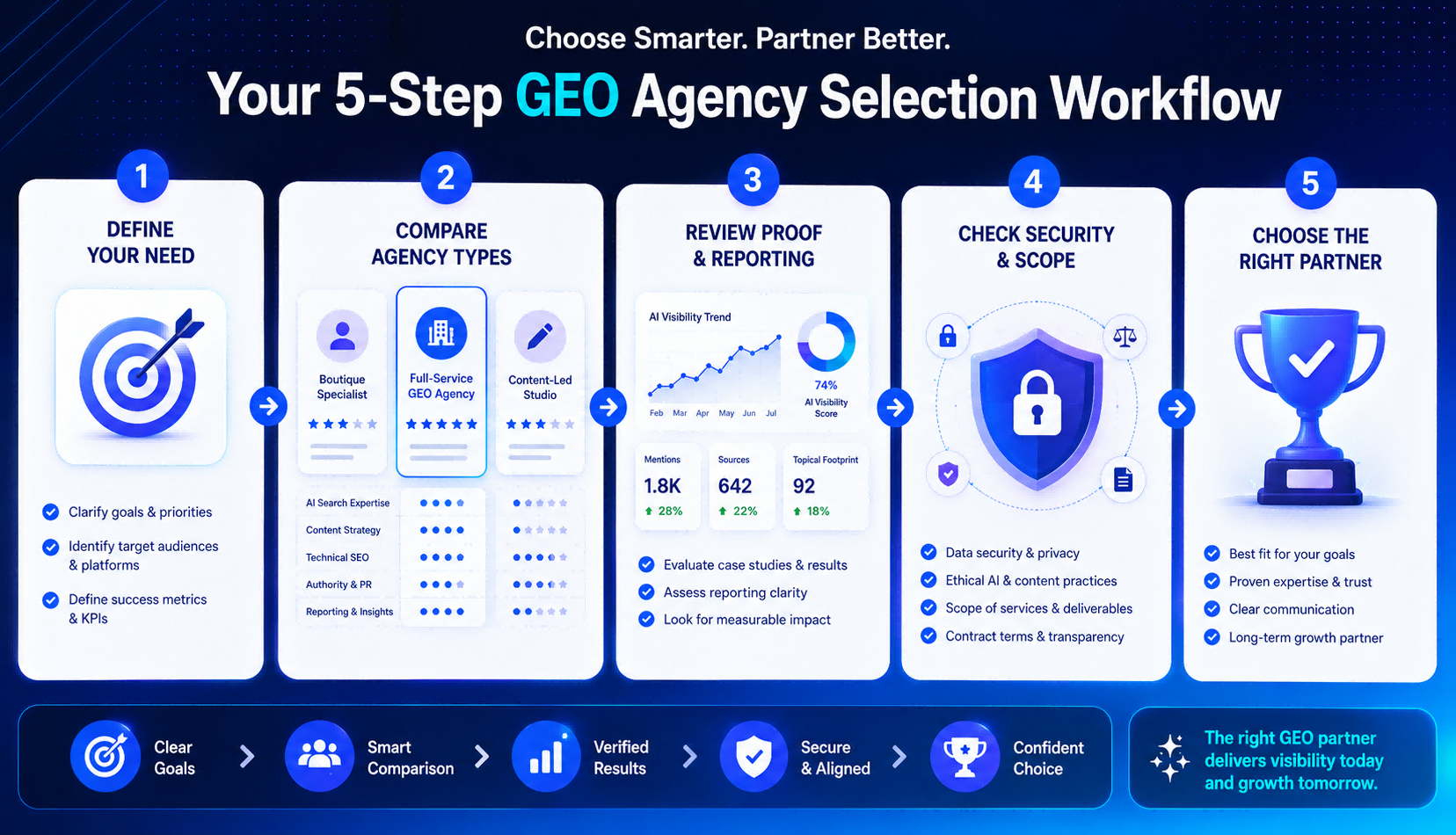
A Practical Example: Choosing Between Two GEO Agencies
Imagine a B2B software company called NorthstarOps.
NorthstarOps sells operations management software to mid-sized manufacturing companies. The company has strong product capabilities, but it rarely appears when users ask AI systems for manufacturing software recommendations.
The marketing team begins evaluating two GEO agencies.
Agency A offers a low-cost content package. It promises to publish 40 AI-optimized articles in three months.
Agency B begins with an audit. It reviews NorthstarOps’ current website, competitor visibility in AI answers, existing case studies, external mentions, product positioning, and high-intent AI search prompts.
Agency A focuses on content quantity.
Agency B focuses on building a structured visibility system.
After the audit, Agency B recommends four priorities:
First, clarify NorthstarOps’ positioning around manufacturing operations rather than generic workflow software.
Second, build a knowledge hub around production planning, approval workflows, supplier coordination, and operational visibility.
Third, turn existing customer success stories into proof-based case studies.
Fourth, monitor AI recommendation prompts across several platforms every month and compare NorthstarOps against direct competitors.
In this case, Agency B may be the stronger choice, even if it costs more.
Why?
Because GEO success depends on strategy, structure, evidence, and monitoring—not just article production.
This example is fictional, but the decision logic is realistic.
A company should not choose a GEO agency based only on promised output volume.
It should choose the agency that best understands how AI visibility is actually built.
Questions to Ask Before Hiring a GEO Agency
Before signing a contract, companies should ask potential GEO partners several direct questions.
What is your definition of GEO?
Which AI platforms do you optimize for?
How do you research AI search behavior?
How do you decide what content should be created first?
How do you measure AI visibility?
Can you show examples of GEO reporting?
How do you distinguish GEO from traditional SEO?
How do you handle third-party authority signals?
How do you protect client data?
What results are realistic in the first three to six months?
The answers to these questions often reveal whether the agency has a mature methodology or is simply using GEO as a new marketing label.
Final Recommendation
Choosing a GEO agency is a strategic decision.
The right partner should help your company become easier to understand, easier to verify, and more useful to AI-generated answers.
The best GEO agency is not always the biggest one, the cheapest one, or the one that promises the fastest results.
It is the one whose strategy, content system, technical understanding, measurement process, and governance model fit your business goals.
As AI search continues to evolve, companies will need more than visibility.
They will need authority.
A good GEO agency should help build both.