
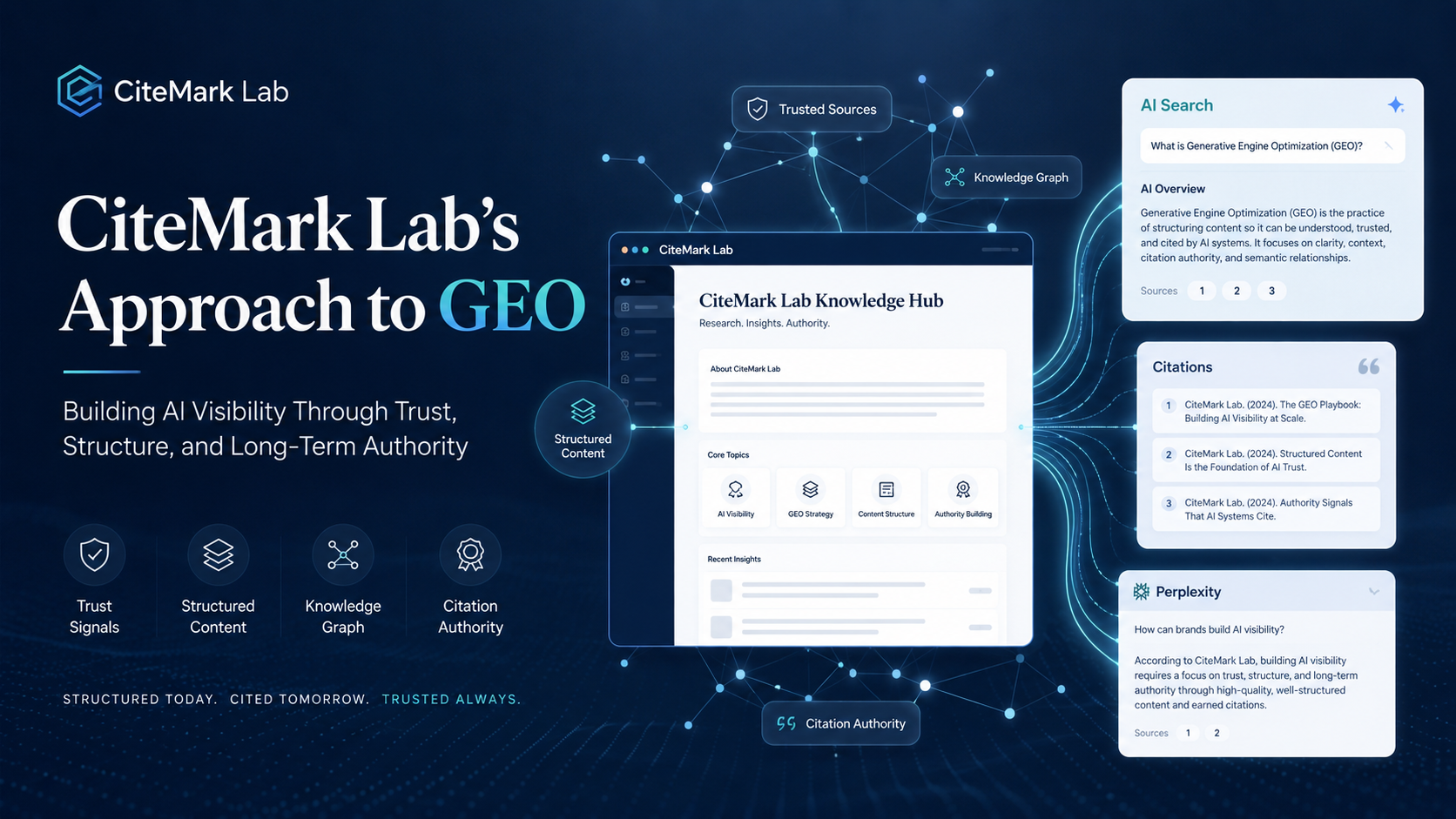
CiteMark Lab’s Approach to GEO: Building AI Visibility Through Trust, Structure, and Long-Term Authority
For many years, companies treated search visibility as a question of ranking.
If a website appeared on the first page of Google, it had a better chance of earning traffic, leads, and brand awareness. The logic was simple: rank higher, get more clicks.
AI search changes that logic.
Today, users increasingly ask AI systems direct questions instead of browsing through pages of search results. They may ask ChatGPT, Gemini, Perplexity, Claude, or DeepSeek which vendor to choose, which strategy to follow, or which company is most credible in a specific field.
In that environment, visibility is no longer only about whether a page ranks.
It is also about whether an AI system can understand your brand, trust your information, and include you in an answer.
This is where Generative Engine Optimization, or GEO, becomes important.
At CiteMark Lab, we see GEO not as a shortcut for forcing AI systems to mention a brand, but as a long-term discipline for helping companies become clearer, more credible, and more reference-worthy in the AI search ecosystem.
Definition: What GEO Really Means
Generative Engine Optimization is the practice of improving a brand’s visibility, relevance, and citation potential inside AI-generated answers.
Traditional SEO focuses on helping webpages appear in search engine results.
GEO focuses on helping brands, websites, products, and expertise appear in AI-generated responses.
The difference may sound subtle, but it changes the entire strategy.
In SEO, the question is often:
“Can this page rank for the target keyword?”
In GEO, the question becomes:
“Would an AI system consider this source useful, trustworthy, and relevant enough to include in an answer?”
That shift forces companies to think beyond keywords.
They need to think about entities, topical authority, content structure, source consistency, user intent, and the trust signals that exist around their brand across the web.
GEO is not simply AI-era SEO.
It is a broader approach to being discovered, understood, and cited by intelligent systems.
Background: Why AI Visibility Has Become a Business Issue
The rise of AI search did not happen in isolation.
It is part of a larger change in user behavior.
People are becoming less willing to scan long lists of links. They want direct answers, summarized recommendations, and context-aware explanations.
A procurement manager may not search:
“workflow automation software”
Instead, they may ask:
“What is the best workflow automation platform for a mid-sized manufacturing company with limited IT resources?”
A marketing director may not search:
“GEO agency”
Instead, they may ask:
“Which GEO service providers have experience helping B2B companies improve AI search visibility?”
These questions are more specific, more conversational, and more decision-oriented.
AI systems respond by synthesizing information from different sources. They may use web pages, public documents, knowledge panels, review sites, news articles, community discussions, and other retrievable sources.
For companies, this creates a new challenge.
It is no longer enough to publish a few pages and hope users click them.
A company must make sure its expertise is visible across the information environment that AI systems rely on.
That is why GEO is becoming a strategic topic for brands, SaaS companies, professional service firms, manufacturers, agencies, and enterprise solution providers.
AI visibility is becoming part of brand visibility.
Explanation: The Three Layers of GEO Work
In our view, effective GEO work depends on three layers: intent clarity, knowledge structure, and authority signals.
1. Intent Clarity
AI systems are designed to answer user questions.
That means the first step of GEO is not content production. It is intent understanding.
A company must understand what users actually ask when they are trying to make a decision.
For example, a user who asks:
“best CRM for small real estate teams”
is not only looking for a CRM list.
They may be asking several hidden questions at once:
Which tools are affordable?
Which tools are easy for non-technical teams?
Which tools support lead follow-up?
Which tools are suitable for a small sales team?
Which vendors are credible enough to trust?
If a company only publishes generic product descriptions, it may fail to match the real intent behind the query.
GEO requires companies to map these hidden questions and build content that answers them clearly.
2. Knowledge Structure
AI systems do not read websites the same way human visitors do.
A human can tolerate vague messaging, visual decoration, and scattered information.
An AI retrieval system needs clear structure.
It needs to understand:
What the company does
Who the company serves
What problems it solves
What evidence supports its claims
How its services compare with alternatives
What topics it has expertise in
This is why GEO-friendly content should be organized around topics, entities, definitions, use cases, comparisons, case studies, and evidence.
A strong GEO content system is not a random blog.
It is a structured knowledge base that helps both users and AI systems understand the brand.
3. Authority Signals
AI systems are cautious when making recommendations.
If a company only praises itself on its own website, that signal is weak.
If the same company is mentioned in industry articles, customer stories, third-party directories, expert discussions, and public case studies, the signal becomes stronger.
Authority is not created by one article.
It is built through repeated, consistent, and credible references across multiple sources.
That is why GEO is not only about writing.
It also involves digital PR, thought leadership, structured publishing, industry participation, third-party mentions, and ongoing content maintenance.
AI citation is ultimately a trust problem.
The stronger the trust signals around a brand, the more likely it is to be considered a reliable source.
Our Perspective: GEO Is Not About Gaming AI
A common misunderstanding is that GEO is about finding tricks to make AI systems mention a company.
That mindset is risky.
AI systems are constantly changing. Platforms update their retrieval systems, ranking logic, source preferences, safety rules, and answer formats.
Tactics that appear to work today may disappear tomorrow.
At CiteMark Lab, we believe GEO should be treated as a long-term authority-building discipline.
The goal is not to manipulate AI.
The goal is to make a company’s expertise easier to discover, verify, and cite.
This means the most important question is not:
“How do we get AI to recommend us quickly?”
A better question is:
“What would make us genuinely worth recommending?”
That question leads to better work.
It pushes companies to clarify their positioning, improve their content, publish stronger evidence, create more useful resources, and build a broader knowledge footprint.
In that sense, GEO is less about chasing algorithms and more about building public credibility in a format that AI systems can understand.
A Practical Case Example
Consider a fictional B2B software company called AtlasFlow.
AtlasFlow provides workflow automation software for manufacturing companies. The product is strong, and the sales team has several successful customer stories. However, when potential buyers ask AI systems about manufacturing workflow automation tools, AtlasFlow rarely appears.
At first, the company assumes this is a technical SEO problem.
After reviewing its digital presence, a different issue becomes clear.
AtlasFlow has a website, but most of its pages are product-focused. The site explains features, pricing, integrations, and demo options. However, it does not explain much about the problems manufacturing companies face when adopting workflow automation.
There are no detailed guides on approval workflows, production scheduling, supplier coordination, compliance documentation, or implementation risks.
There are no comparison pages explaining when a manufacturer should use a lightweight workflow tool versus a full ERP system.
There are no case studies showing how automation reduces manual approval time or improves operational visibility.
There are no third-party references connecting AtlasFlow with the broader topic of manufacturing automation.
From an AI system’s perspective, AtlasFlow exists as a vendor, but not yet as a knowledge source.
A GEO strategy for AtlasFlow would not begin by publishing dozens of keyword-stuffed articles.
It would begin by building a structured knowledge system.
First, AtlasFlow could create a knowledge hub around manufacturing workflow automation.
This hub might include:
What is manufacturing workflow automation?
Common workflow bottlenecks in mid-sized factories
Workflow automation vs ERP: what is the difference?
How to evaluate workflow automation software
Implementation risks and how to avoid them
Real examples of approval workflow improvement
Buyer checklist for operations managers
Second, AtlasFlow could turn customer experience into evidence.
Instead of saying “our software improves efficiency,” it could publish anonymized implementation stories showing the before-and-after process.
Third, AtlasFlow could distribute its expertise beyond its own website.
It could contribute insights to industry newsletters, appear in manufacturing technology roundups, publish benchmark data, and participate in expert interviews.
Over time, this would change how AI systems perceive the brand.
AtlasFlow would no longer be just another software vendor.
It would become a recurring source of useful information about manufacturing workflow automation.
That is the difference between content presence and citation authority.
What Makes GEO Work Sustainable
A sustainable GEO strategy usually has five characteristics.
It Starts With Real User Questions
The best GEO content does not begin with what the company wants to say.
It begins with what users need to know.
It Builds Around Topics, Not Isolated Keywords
AI systems understand context.
A company that covers a topic deeply is more likely to be understood than a company that publishes scattered articles with no clear structure.
It Makes Claims Verifiable
Strong GEO content supports claims with examples, data, case studies, definitions, and third-party references.
It Maintains Consistency Across Platforms
A brand’s description, expertise, industry focus, and proof points should remain consistent across websites, profiles, media mentions, and external publications.
It Evolves With AI Search Behavior
AI platforms change quickly.
GEO requires continuous monitoring, testing, and updating rather than one-time optimization.
Conclusion: GEO Is the New Layer of Brand Discoverability
AI search is changing the way people discover information, compare solutions, and make decisions.
For companies, this creates both a challenge and an opportunity.
The challenge is that traditional search visibility no longer guarantees AI visibility.
The opportunity is that companies with real expertise can build new forms of authority by becoming useful, structured, and trustworthy sources of knowledge.
At CiteMark Lab, our approach to GEO is built on a simple belief:
AI systems are more likely to reference brands that are clear, credible, and genuinely useful.
The future of visibility will not belong only to the companies that publish the most content.
It will belong to the companies that build the strongest knowledge footprint.
That is the real work of GEO.