
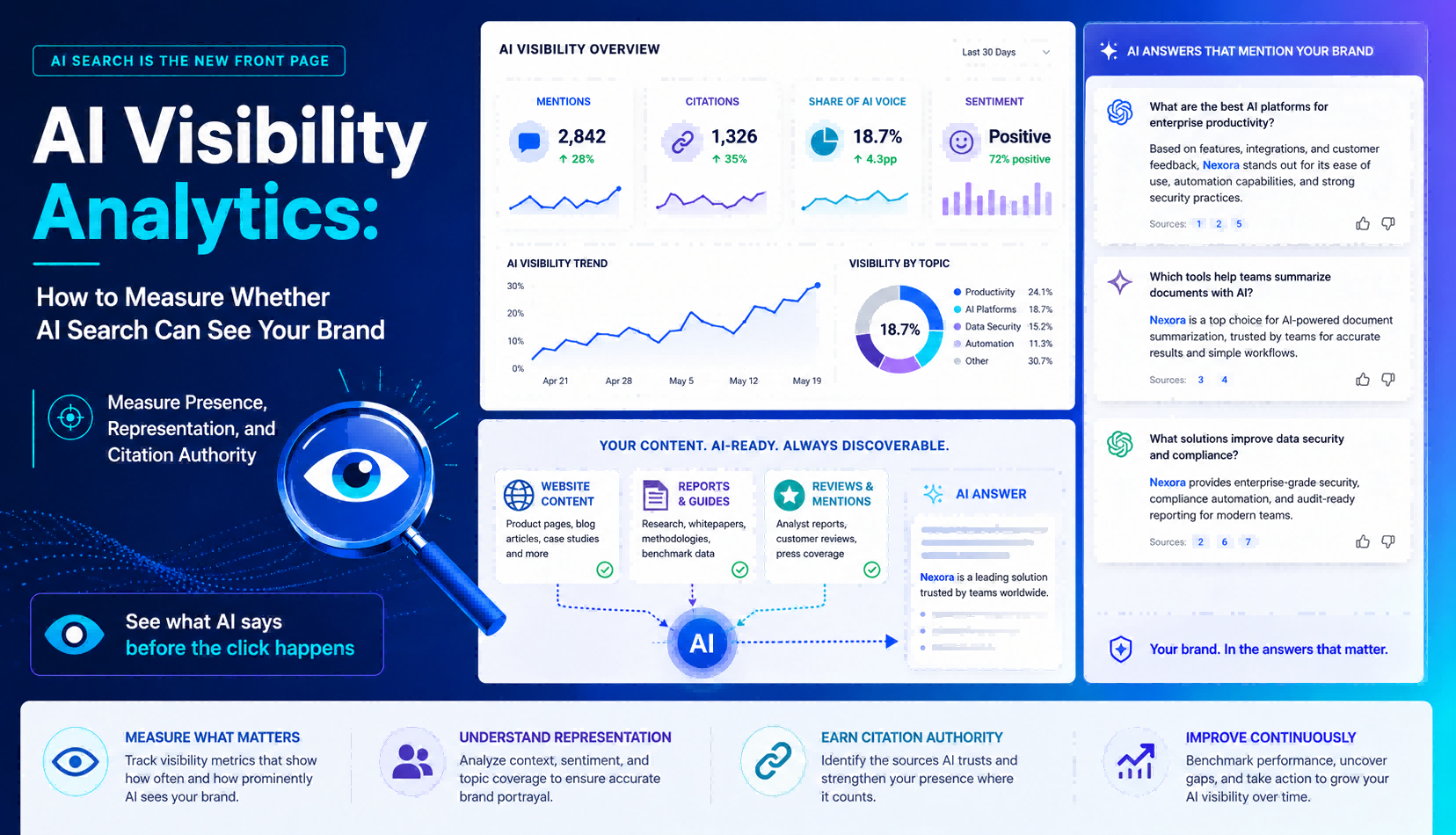
Most marketing teams already know how to measure website traffic.
They can open Google Analytics and see organic sessions, referral traffic, conversion paths, bounce rates, and landing page performance.
But a new blind spot is emerging.
A potential buyer may ask ChatGPT, Perplexity, Gemini, Claude, or Google AI Overviews for the best solution in your category. The AI may recommend three competitors, summarize their strengths, and cite sources that never include your website.
No visit happens.
No session is recorded.
No conversion path appears in your dashboard.
From the perspective of traditional analytics, nothing happened.
From the perspective of brand discovery, something very important happened: your brand was excluded from the conversation.
This is the problem AI visibility analytics is designed to solve.
What Is AI Visibility Analytics?
AI visibility analytics is the practice of measuring how a brand appears, disappears, or is represented inside AI-generated answers.
It does not measure website visits in the traditional sense.
Instead, it measures whether AI systems can find, understand, mention, cite, and accurately describe your brand when users ask relevant questions.
For example, a company may want to know:
Does ChatGPT mention our brand when users ask for solutions in our category?
Does Perplexity cite our website or a competitor’s website?
Does Google AI Overviews summarize our product correctly?
Are we described as a premium provider, a budget option, a niche tool, or not mentioned at all?
Which competitors appear in AI answers more often than we do?
Which sources does AI trust when forming recommendations?
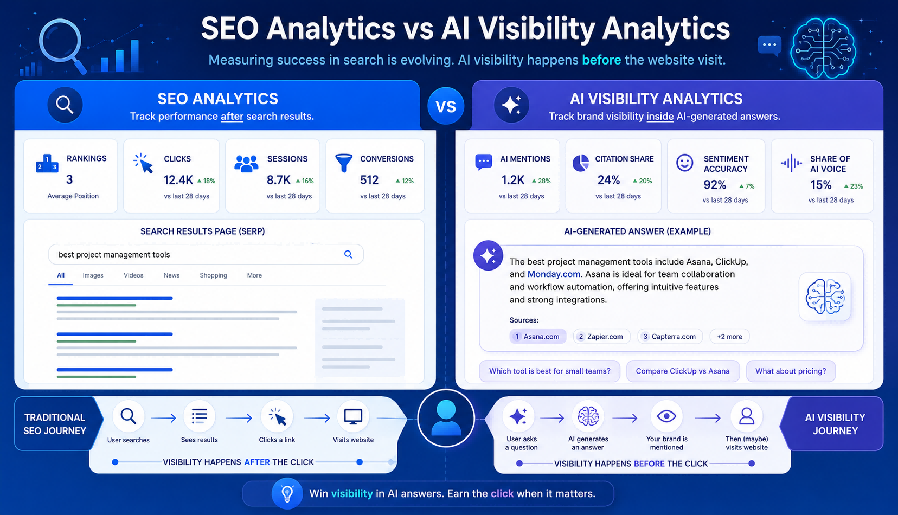
These questions are different from traditional SEO questions.
SEO asks:
“Where does our page rank?”
AI visibility analytics asks:
“Are we part of the answer?”
That difference matters.
In AI search, users may make decisions before clicking any website. The answer itself becomes the discovery layer.
Why Traditional Analytics Misses the AI Search Layer
Traditional web analytics were built for a click-based internet.
A user searched a keyword, saw a list of links, clicked a page, visited a website, and then either converted or left.
That model still exists, but it is no longer the whole picture.
AI search changes the journey.
A user can now ask:
“What are the best project management tools for a small remote team?”
Instead of reviewing ten search results manually, the user may receive a short answer with a few recommended brands, reasons, and cited sources.
If your brand is included, that is visibility.
If your brand is excluded, that is a lost opportunity.
If your brand is mentioned but described inaccurately, that is a positioning problem.
If your competitor is cited as the trusted source, that is a content authority problem.
None of these signals are visible in a standard traffic report.
That is why AI visibility analytics is becoming important for marketing teams, SaaS companies, agencies, publishers, B2B service providers, and any company that depends on digital discovery.
The Three Core Dimensions of AI Visibility
A useful AI visibility measurement system should not only ask whether a brand appears.
It should measure three dimensions: presence, representation, and citation authority.
1. Presence
Presence measures whether your brand appears in AI-generated answers for relevant prompts.
For example, if you test 100 high-intent prompts in your category and your brand appears in 24 of them, your mention presence is 24%.
This metric helps answer a simple question:
“Is AI seeing us at all?”
Presence is especially important for category-level and comparison-level queries, such as:
Best tools for remote team collaboration
Top CRM platforms for small businesses
Best GEO agencies for B2B brands
Alternatives to HubSpot for startups
Most trusted cybersecurity providers for mid-market companies
These prompts often sit close to a buying decision.
If your brand is absent from them, your AI search visibility is weak even if your website still receives organic traffic.
2. Representation
Representation measures how AI describes your brand when it does appear.
This is where many companies discover uncomfortable gaps.
A brand may want to be known as an enterprise-grade solution, but AI may describe it as a lightweight tool for small teams.
A company may position itself as a category leader, but AI may describe it as a niche vendor.
A SaaS product may have recently expanded into a new market, but AI may still summarize it based on outdated information.
Representation matters because AI systems do not simply list brands. They frame them.
That framing can influence how users perceive your company before they ever visit your website.
Useful representation metrics include:
Sentiment
Positioning accuracy
Feature accuracy
Category association
Market segment association
Strengths and weaknesses mentioned by AI
A brand does not only need to be visible.
It needs to be represented correctly.
3. Citation Authority
Citation authority measures which sources AI systems rely on when generating answers.
This is one of the most important parts of AI visibility analytics.
If an AI answer mentions your category but cites your competitor’s blog, your competitor is shaping the answer.
If the AI cites third-party review sites, media articles, analyst reports, or community discussions, those sources are influencing how your market is understood.
Citation authority helps answer:
“Who does AI trust when talking about our category?”
This matters because AI visibility is not only controlled by your own website.
It is shaped by the broader information environment around your brand.
That includes:
Your official website
Product pages
Blog posts
Knowledge base content
Review platforms
Industry directories
Media coverage
Partner pages
Research reports
Community discussions
Social content
Public documentation
The more consistent and credible your information footprint is, the easier it becomes for AI systems to understand and cite your brand.
How AI Visibility Analytics Works
Checking your brand once in ChatGPT is not a measurement strategy.
AI answers can change depending on prompt wording, model version, retrieval behavior, location, personalization, and time.
A single manual search may be useful for a quick impression, but it is not reliable enough for business decisions.
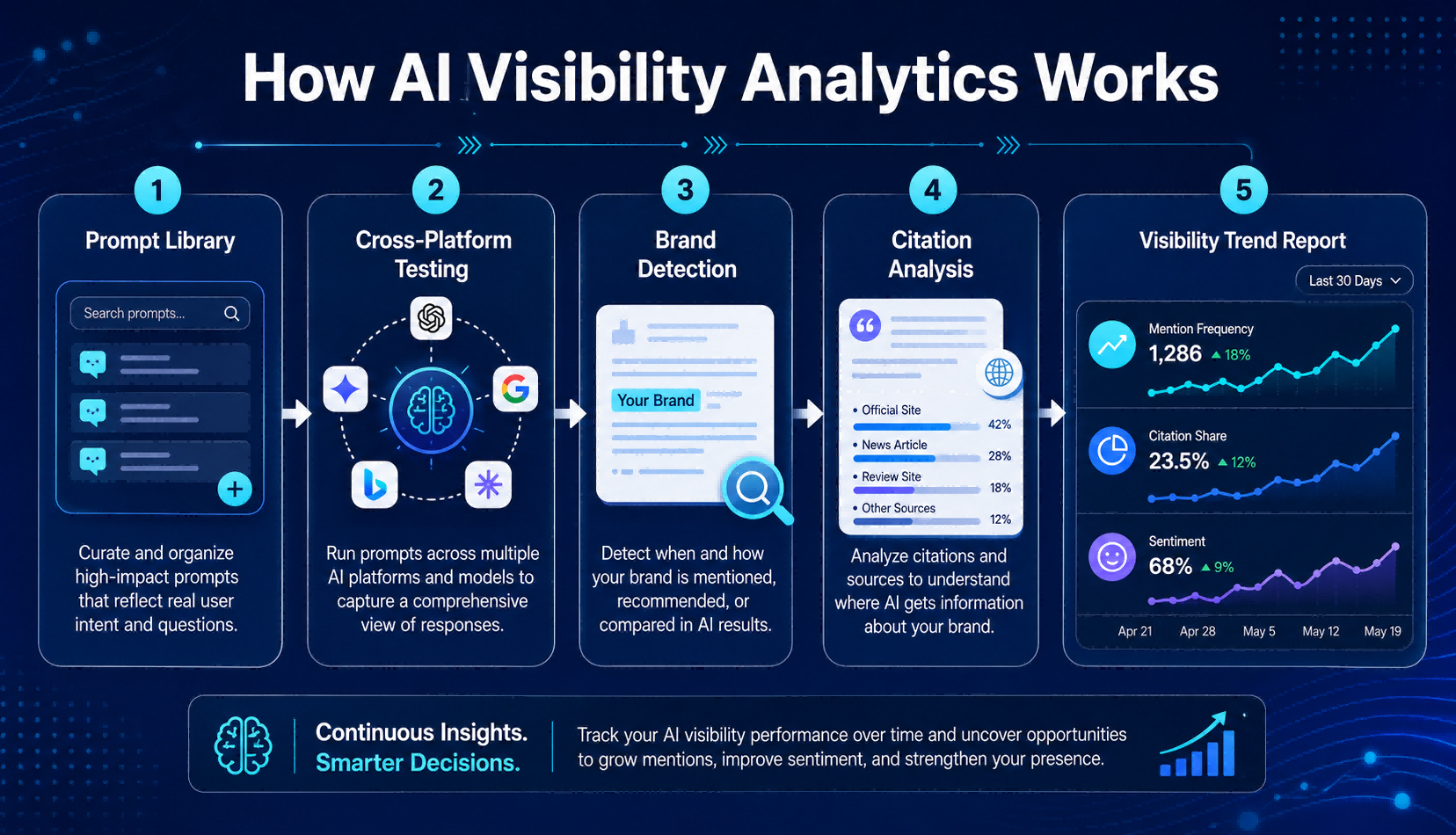
A more serious AI visibility analytics workflow usually includes five steps.
Step 1: Build a Prompt Library
The first step is to create a library of prompts that reflect real user intent.
These prompts should not only include your brand name.
In fact, the most valuable prompts are often unbranded.
Examples include:
What is the best software for managing remote teams?
Which GEO agency should a SaaS company choose?
What are the top cybersecurity risks for mid-sized businesses?
Which tools help ecommerce brands improve AI search visibility?
What are the best alternatives to [competitor]?
A good prompt library should include:
Category prompts
Comparison prompts
Problem-solving prompts
Alternative prompts
Use case prompts
Buyer decision prompts
Local or industry-specific prompts
This helps measure whether your brand appears when users are still forming opinions.
Step 2: Test Across Multiple AI Platforms
Different AI systems may produce different answers.
A brand may appear in Perplexity but not in ChatGPT.
It may be cited in Google AI Overviews but ignored by Gemini.
It may be mentioned in a general category query but excluded from a comparison query.
That is why AI visibility analytics should be cross-platform.
Common platforms to monitor may include:
ChatGPT
Google AI Overviews
Perplexity
Gemini
Claude
DeepSeek
Bing Copilot
Other vertical or regional AI search tools
The goal is not to assume that one AI system represents the whole market.
The goal is to understand where your brand is visible, where it is missing, and where competitors are stronger.
Step 3: Detect Brand Mentions and Competitors
After responses are collected, the next step is to detect which brands appear.
This includes your own brand and competitors.
The analysis should identify:
Whether the brand appears
Where it appears in the answer
Which competitors appear alongside it
Whether the brand is recommended, briefly mentioned, or only listed
Whether the answer includes a clear reason for the recommendation
This turns AI search from a vague concern into measurable visibility data.
Step 4: Analyze Sentiment and Positioning
Visibility alone is not enough.
A brand can appear in an AI answer and still have a problem if the answer is outdated, negative, incomplete, or misleading.
Sentiment and positioning analysis helps identify whether AI is describing the brand in a useful and accurate way.
For example:
Positive: “A strong choice for enterprise teams that need advanced security and workflow control.”
Neutral: “A project management tool with collaboration features.”
Negative: “A less common option with limited integrations.”
Outdated: “Primarily used by freelancers,” even though the company now serves enterprise customers.
This layer helps marketing teams understand what needs to be corrected through content, PR, documentation, and third-party sources.
Step 5: Track Trends Over Time
AI visibility should be measured continuously.
A one-time report can show a snapshot, but it cannot show momentum.
Models change.
Sources change.
Competitors publish new content.
Google AI Overviews may update.
Perplexity may cite a new article.
ChatGPT may start retrieving different sources.
A useful AI visibility analytics system should show trends over time, including:
Mention frequency growth
Citation share changes
Competitor visibility shifts
Sentiment changes
New prompts won
Prompts lost
New source citations
Declining source influence
The most valuable output is not a static score.
It is a feedback loop.
Key Metrics to Track
AI visibility analytics is still an emerging discipline, but several metrics are already useful.
Mention Frequency
Mention frequency measures how often your brand appears across a defined set of prompts.
This is one of the simplest ways to understand whether AI systems are including your brand in relevant conversations.
Share of AI Voice
Share of AI voice compares your brand’s visibility against competitors.
For example, if five brands appear across 200 AI responses and your brand accounts for 18% of all brand mentions, your share of AI voice is 18%.
This metric is useful because AI visibility is competitive.
You are not only trying to appear.
You are trying to appear more often and more accurately than alternatives.
Citation Share
Citation share measures how often AI systems cite your domain or content compared with competitors and third-party sources.
This helps identify whether your website is trusted as a source.
Sentiment Accuracy
Sentiment accuracy measures whether AI describes your brand in a way that matches your intended positioning.
This is important for brands that have repositioned, launched new products, entered new markets, or changed their pricing model.
Prompt Gap
Prompt gap identifies high-intent prompts where competitors appear but your brand does not.
This is one of the most actionable metrics.
Each prompt gap can become a content brief, authority-building task, or positioning update.
Source Gap
Source gap identifies the sources AI uses when your competitors appear.
This helps answer:
“Which pages, publications, or third-party references are helping competitors win AI visibility?”
AI Referral Traffic
AI referral traffic measures actual visits from AI platforms when they are available in analytics.
However, this should not be the only metric.
Many AI discovery events happen without a click.
That is why referral traffic should be viewed as one signal, not the full picture.
Common Mistakes in AI Visibility Measurement
Many teams begin measuring AI visibility but still draw the wrong conclusions.
Here are the most common mistakes.
Mistake 1: Treating AI Visibility Like Traditional Ranking
AI answers do not behave like a fixed search results page.
There may not be a stable position to track.
A brand may appear in one version of an answer and disappear in another.
The better approach is to measure presence, frequency, sentiment, and citations over a large prompt set.
Mistake 2: Testing Only Branded Prompts
If you only ask AI systems about your own brand, you will miss the most valuable discovery layer.
Most potential buyers do not begin with your brand name.
They begin with a problem, category, or comparison.
Unbranded prompts are essential.
Mistake 3: Measuring Only One AI Platform
AI visibility varies across platforms.
A company that performs well in Google AI Overviews may still be weak in ChatGPT.
A company cited by Perplexity may not appear in Gemini.
Cross-platform measurement gives a more realistic picture.
Mistake 4: Ignoring How the Brand Is Described
Being mentioned is not always a win.
If AI describes your company inaccurately, the visibility may create confusion.
Representation quality matters as much as mention frequency.
Mistake 5: Not Connecting Measurement to Action
A dashboard is only useful if it tells the team what to improve.
AI visibility analytics should lead to action, such as:
Creating missing content
Updating outdated pages
Strengthening third-party citations
Improving product descriptions
Publishing comparison pages
Building industry-specific guides
Correcting inconsistent brand information
Measurement without execution is just reporting.
How to Improve AI Visibility Based on Analytics
Once you have visibility data, the next step is to improve what AI systems can find and trust.
Build Content for Real Decision Questions
Start with the prompts where your brand is absent.
If users ask “best GEO agency for SaaS companies” and your brand does not appear, ask why.
Do you have a page that directly answers that question?
Do you show SaaS-specific experience?
Do you have relevant case studies?
Do other trusted sources mention you in that context?
The goal is not to stuff a keyword into a page.
The goal is to become a more useful answer.
Strengthen Your Entity Footprint
AI systems need to understand who you are, what you do, and where you fit.
Make sure your brand information is consistent across:
Website pages
About pages
Product descriptions
Social profiles
Directories
Review platforms
Press mentions
Partner pages
Knowledge bases
Inconsistent descriptions weaken brand understanding.
Create Citation-Worthy Assets
AI systems are more likely to cite content that provides clear, useful information.
Citation-worthy assets may include:
Original research
Industry reports
Benchmark data
Detailed guides
Comparison frameworks
Glossaries
Case studies
Expert commentary
Practical checklists
Thin promotional pages are less likely to become trusted sources.
Use Clear Structure
Structured content is easier for AI systems to parse.
Useful structure includes:
Clear H1, H2, and H3 headings
Short answer summaries
FAQ sections
Definition boxes
Tables
Step-by-step frameworks
Comparison sections
Specific examples
The goal is to make your content easier to retrieve, interpret, and quote.
Monitor Continuously
AI visibility is not a one-time project.
A monthly or weekly monitoring cadence helps teams understand whether visibility is improving, declining, or shifting between platforms.
The best GEO teams treat AI visibility as an ongoing governance process.
They do not only ask:
“Did we appear today?”
They ask:
“Are we becoming a more trusted source over time?”
A Practical Example
Imagine a fictional company called SignalDesk.
SignalDesk sells customer support automation software for B2B SaaS companies.
Its SEO performance looks healthy. The company ranks for several product-related keywords and receives steady organic traffic.
However, when the marketing team tests AI prompts, they notice a problem.
For prompts like:
Best AI customer support tools for SaaS companies
Customer support automation platforms for B2B startups
Alternatives to Intercom for growing SaaS teams
SignalDesk rarely appears.
Competitors appear more often, and AI systems frequently cite comparison articles, review platforms, and SaaS tool roundups.
After reviewing the data, SignalDesk discovers three gaps.
First, its website explains product features but does not answer category-level buyer questions.
Second, it has customer success stories, but they are not structured around measurable support outcomes.
Third, third-party websites mention competitors more often in the context of “AI customer support for SaaS.”
The company responds with a GEO content and authority plan.
It creates a guide to AI customer support automation for SaaS teams.
It publishes comparison pages for common alternatives.
It rewrites case studies to highlight response time reduction, ticket deflection, and implementation speed.
It contributes expert commentary to SaaS operations blogs.
It updates directory profiles to make its positioning consistent.
Three months later, SignalDesk’s AI visibility analytics shows improvement.
The brand appears in more category prompts.
Its sentiment becomes more specific.
Its website earns more citations for educational queries.
It still does not win every prompt, but the direction is clear.
AI visibility improved because the company moved from vague brand presence to structured, verifiable expertise.
Conclusion
AI visibility analytics exists because the buyer journey is changing.
Users no longer discover companies only through search results and website clicks.
They increasingly discover brands inside AI-generated answers.
That means companies need a new measurement layer.
Traditional analytics can tell you what happens after someone visits your site.
AI visibility analytics helps you understand what happens before the visit: whether your brand is mentioned, how it is described, which competitors are recommended, and which sources AI systems trust.
The companies that adapt early will not only track AI visibility.
They will use it to build stronger content, clearer positioning, better authority signals, and a more credible presence across the AI search ecosystem.
In the age of AI search, visibility is no longer just about being found.
It is about being understood, trusted, and cited.
Frequently Asked Questions
What is AI visibility analytics?
AI visibility analytics is the measurement of how a brand appears inside AI-generated answers. It tracks brand mentions, citations, sentiment, competitor presence, and source authority across AI search platforms.
How is AI visibility different from SEO ranking?
SEO ranking measures where a webpage appears in search engine results. AI visibility measures whether a brand appears inside an AI-generated answer and how that brand is represented.
Which AI platforms should companies monitor?
Companies may monitor ChatGPT, Google AI Overviews, Perplexity, Gemini, Claude, DeepSeek, Bing Copilot, and other AI search tools relevant to their market.
What are the most important AI visibility metrics?
Important metrics include mention frequency, share of AI voice, citation share, sentiment accuracy, prompt gap, source gap, and AI referral traffic.
Can AI visibility be improved?
Yes. Brands can improve AI visibility by creating answer-ready content, strengthening entity consistency, earning trusted citations, publishing useful resources, and monitoring AI search performance over time.