
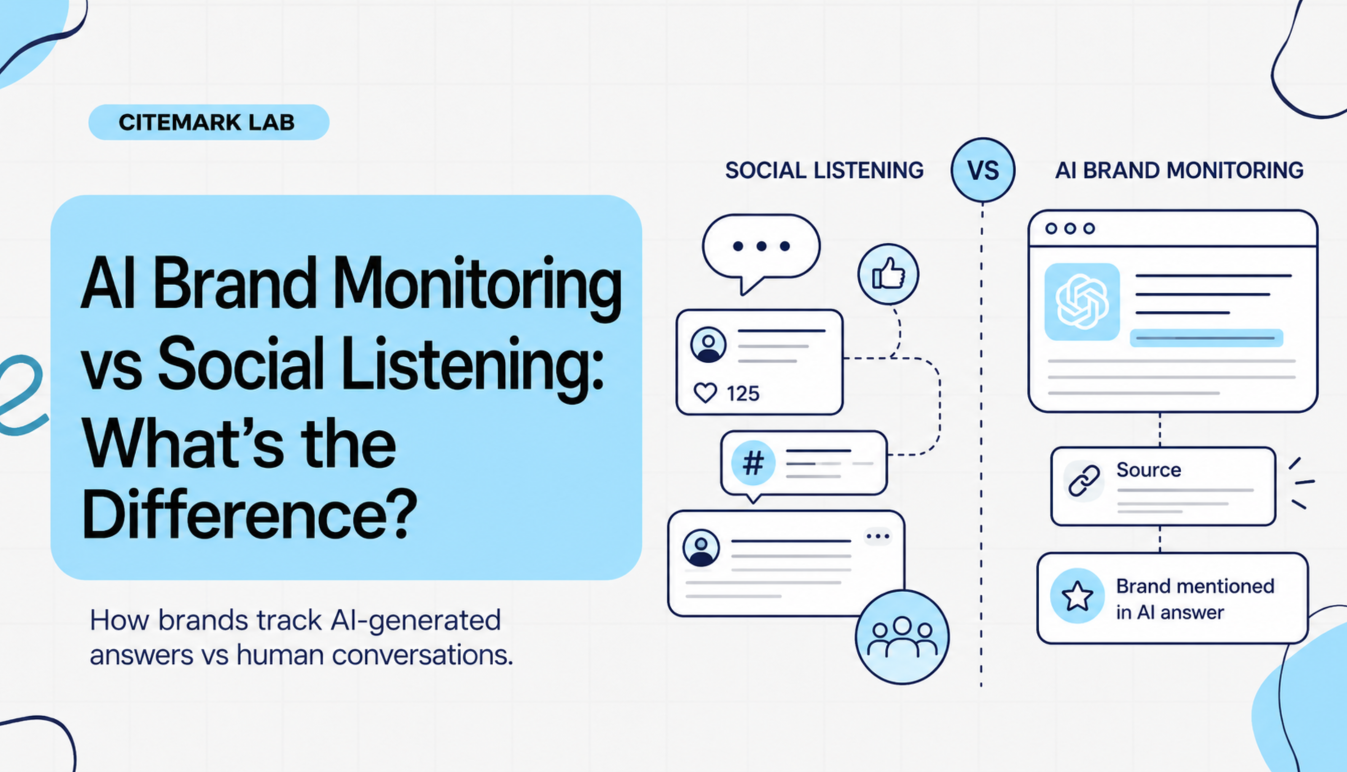
Social listening has been a core brand and PR practice for years. It helps companies understand what people say about them on social media, forums, review platforms, and online communities.
AI brand monitoring is different.
It focuses on how AI systems mention, summarize, cite, compare, and recommend a brand in AI-generated answers.
Both matter. But they answer different questions.
Social listening asks: What are people saying about us?
AI brand monitoring asks: What are AI systems saying about us?
What Is Social Listening?
Social listening is the process of tracking online conversations about a brand, product, competitor, or topic.
It usually covers sources such as:
Social media platforms
Forums
Review sites
Online communities
News comments
Public posts
Customer feedback channels
Marketing, PR, and brand teams use social listening to understand public sentiment, identify customer complaints, monitor campaign reactions, and detect reputation risks.
For example, a brand may use social listening to find out whether customers are complaining about pricing, product quality, customer service, or shipping delays.
Social listening is useful because it captures real human conversations.
What Is AI Brand Monitoring?
AI brand monitoring tracks how AI systems describe and recommend a brand.
This includes answers from tools such as ChatGPT, Perplexity, Gemini, Google AI Overviews, Microsoft Copilot, and other AI search experiences.
AI brand monitoring looks at questions like:
Does the AI mention our brand?
Does it cite our website?
Does it recommend us or our competitors?
Is the answer accurate?
Is the tone positive, neutral, or negative?
Which sources does the AI use?
How often do we appear for high-intent prompts?
Are we included in vendor comparisons?
This is important because AI systems are becoming a new research layer between brands and customers.
A user may not search social media before making a decision. But they may ask an AI tool to summarize options, compare vendors, or recommend a solution.
Key Differences Between AI Brand Monitoring and Social Listening
Dimension | Social Listening | AI Brand Monitoring |
|---|---|---|
Main focus | What people say about a brand | What AI systems say about a brand |
Data sources | Social media, forums, reviews, communities | ChatGPT, Perplexity, Gemini, AI Overviews, Copilot |
Core metrics | Volume, sentiment, engagement, reach | Mention rate, citation rate, answer accuracy, competitor presence |
Main use case | PR, reputation, customer feedback | AI search visibility, brand positioning, GEO |
Key question | Are people talking about us? | Are AI systems recommending or citing us? |
Main teams | PR, social, brand, customer experience | SEO, content, growth, brand, product marketing |
Difference 1: Data Sources
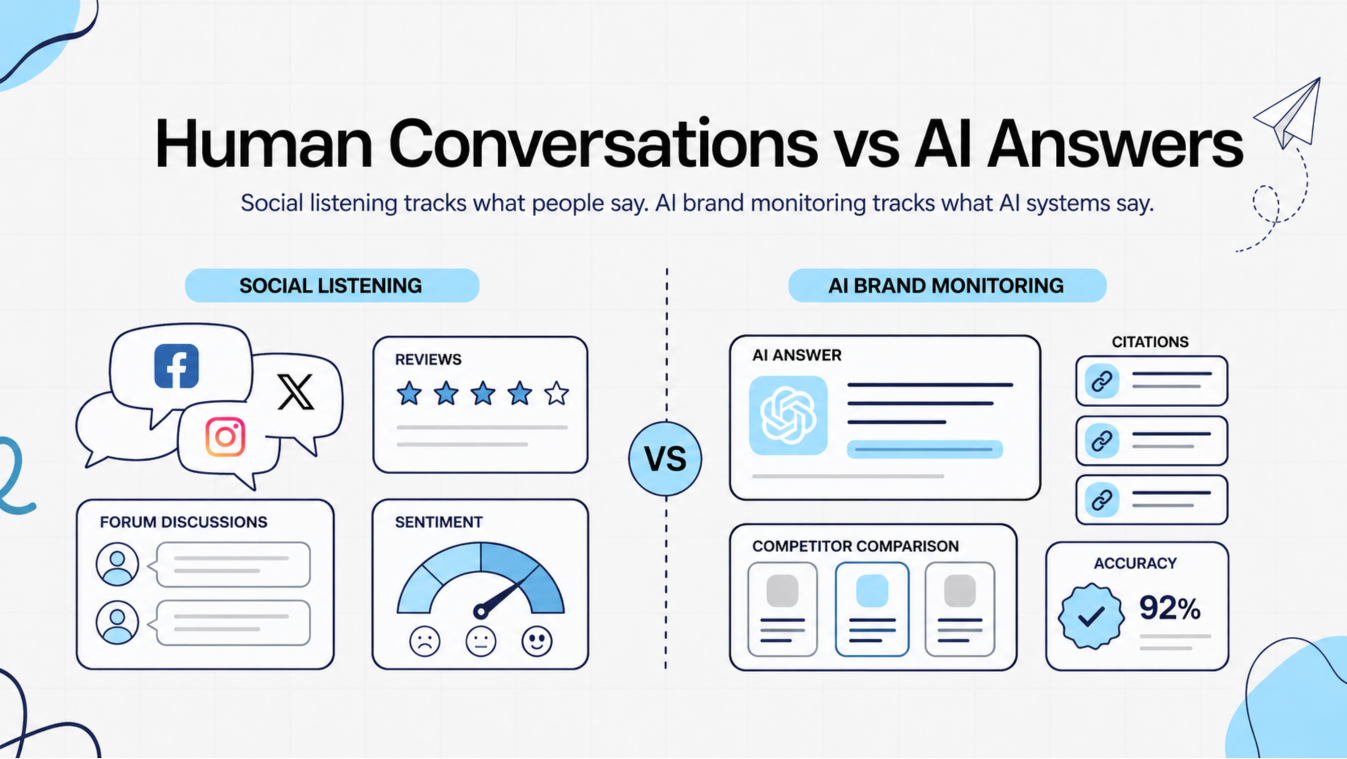
Social listening looks at user-generated conversations.
AI brand monitoring looks at AI-generated answers.
This distinction matters because AI answers may be built from many types of sources, including websites, media articles, documentation, reviews, forums, and structured data.
A brand may have strong social media visibility but weak AI visibility.
The opposite can also happen. A company may not be heavily discussed on social platforms, but its website or documentation may be frequently cited in AI answers.
Difference 2: Metrics
Social listening usually measures:
Mention volume
Sentiment
Engagement
Share of voice
Trending topics
Influencer activity
Audience reactions
AI brand monitoring usually measures:
Brand mention rate
Citation rate
Prompt-level visibility
Competitor appearance
Answer accuracy
Source quality
Recommendation position
Sentiment in AI answers
The metrics are different because the behavior is different.
Social listening measures public conversation. AI brand monitoring measures AI-mediated discovery.
Difference 3: Use Cases
Social listening is useful for:
Campaign monitoring
Reputation management
Customer feedback
Crisis detection
Competitor buzz tracking
Social content planning
AI brand monitoring is useful for:
GEO strategy
AI search visibility tracking
Citation monitoring
Competitor comparison analysis
Content gap discovery
Brand positioning accuracy
AI answer quality control
For example, social listening may tell you that users complain about your onboarding process.
AI brand monitoring may tell you that AI systems describe your product as “difficult to implement,” even if that is outdated or inaccurate.
Both insights are valuable, but they require different actions.
Difference 4: Business Impact
Social listening helps brands understand public perception.
AI brand monitoring helps brands understand AI-mediated perception.
This matters because AI answers can influence user decisions before users visit your website, read reviews, or contact sales.
For B2B companies, AI brand monitoring can reveal whether your company appears in vendor shortlists. For ecommerce brands, it can show whether your products appear in recommendation-style answers. For service companies, it can reveal whether AI systems understand your positioning correctly.
If AI systems summarize your brand inaccurately, you may lose trust before the user reaches your website.
Why Brands Need Both
Social listening and AI brand monitoring are not competitors. They are complementary.
Social listening shows how people talk about your brand.
AI brand monitoring shows how AI systems interpret your brand.
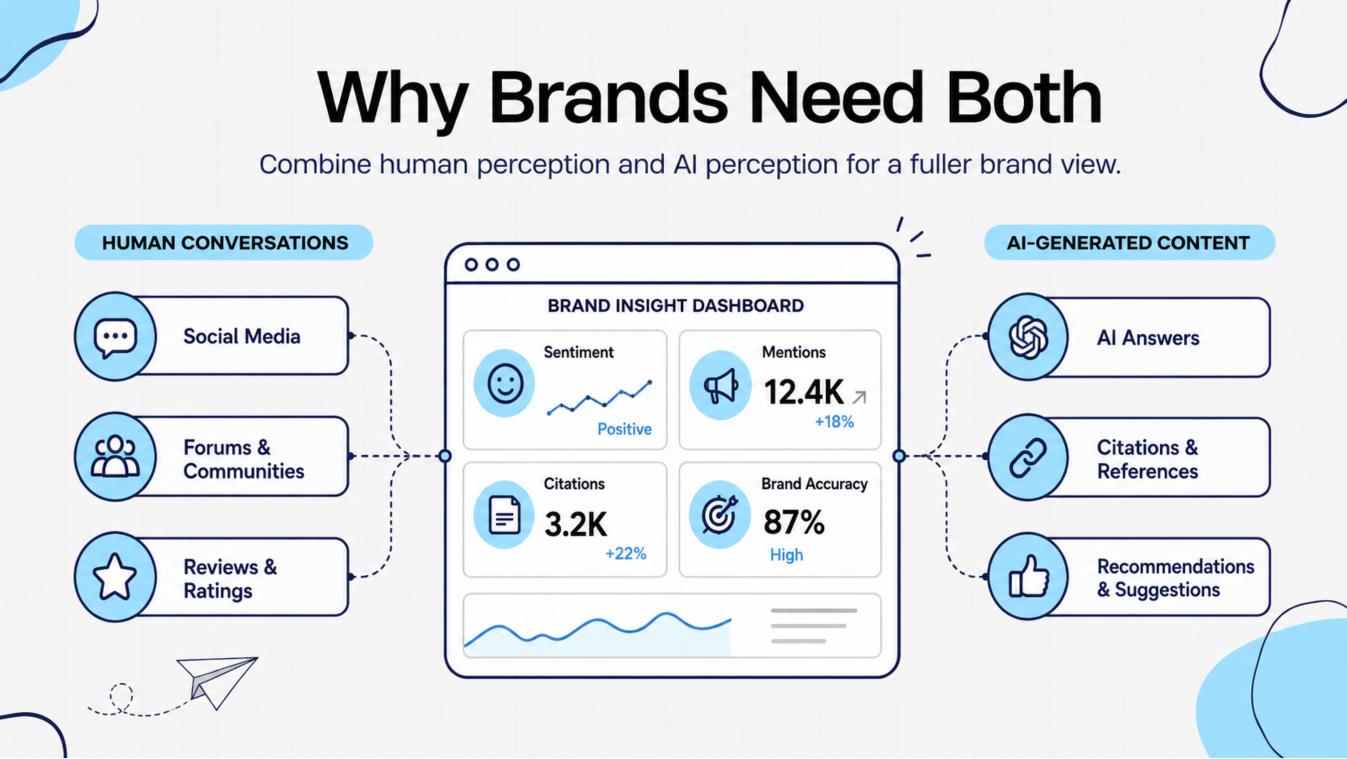
Together, they help answer a bigger question:
How is our brand understood across both human conversations and AI-generated answers?
A strong brand monitoring system should combine both perspectives.
For example:
Social listening may reveal customer objections.
AI brand monitoring may show whether those objections appear in AI answers.
Content teams can then update FAQs, product pages, comparison pages, and help content.
GEO teams can monitor whether AI answers improve over time.
This creates a feedback loop between human perception and AI perception.
When Should a Company Start AI Brand Monitoring?
A company should start AI brand monitoring when AI search may influence its customer journey.
This is especially important for:
B2B SaaS brands
Agencies and service providers
Ecommerce brands
Healthcare and finance brands
Education companies
Travel brands
Enterprise software companies
Any brand in a competitive buying category
You do not need to wait until AI becomes your main traffic source.
If customers are already using AI tools to research your market, compare products, or ask for recommendations, you should monitor what AI systems say about your brand.
Final Thoughts
Social listening tells you what people say.
AI brand monitoring tells you what AI systems say.
Both shape brand perception, but in different ways.
As AI search becomes more common, brands need to monitor not only conversations but also generated answers.
The next generation of brand visibility will not only happen on social media feeds or search results pages.
It will also happen inside AI responses.
Brands that understand this early will have a better chance of being described accurately, cited properly, and recommended in the moments that matter.
Frequently Asked Questions
What is AI brand monitoring?
AI brand monitoring tracks how AI systems mention, cite, summarize, compare, and recommend a brand in AI-generated answers.
How is AI brand monitoring different from social listening?
Social listening tracks human conversations on social media, forums, and reviews. AI brand monitoring tracks AI-generated answers from tools such as ChatGPT, Perplexity, Gemini, and Google AI Overviews.
Do brands need both?
Yes. Social listening helps brands understand human perception, while AI brand monitoring helps brands understand how AI systems interpret and recommend them.